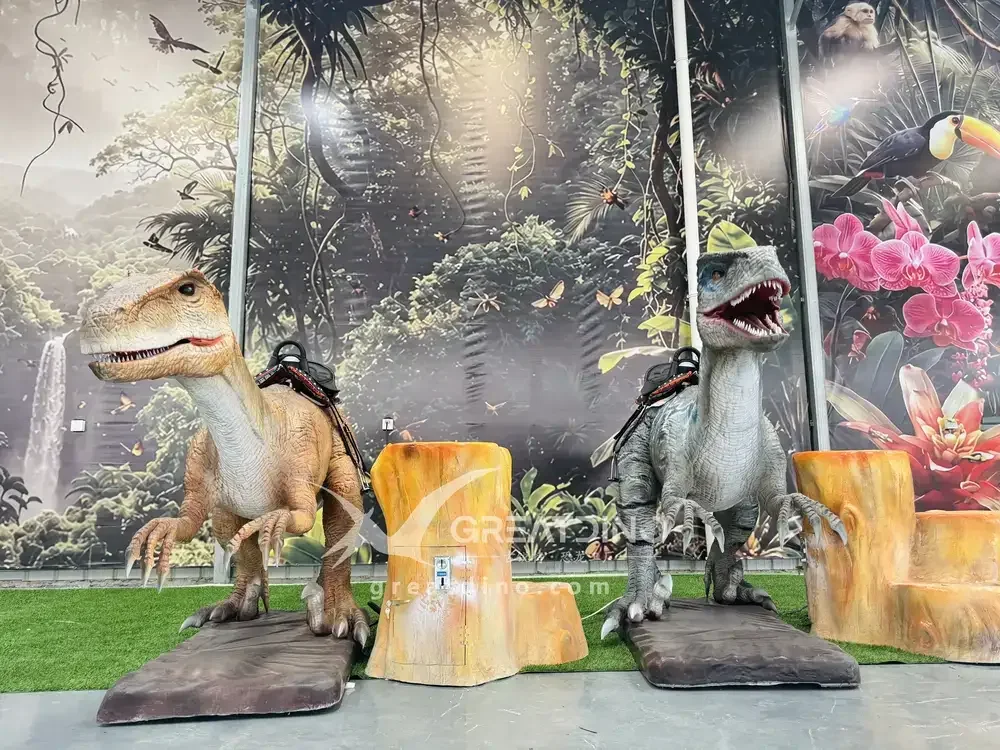
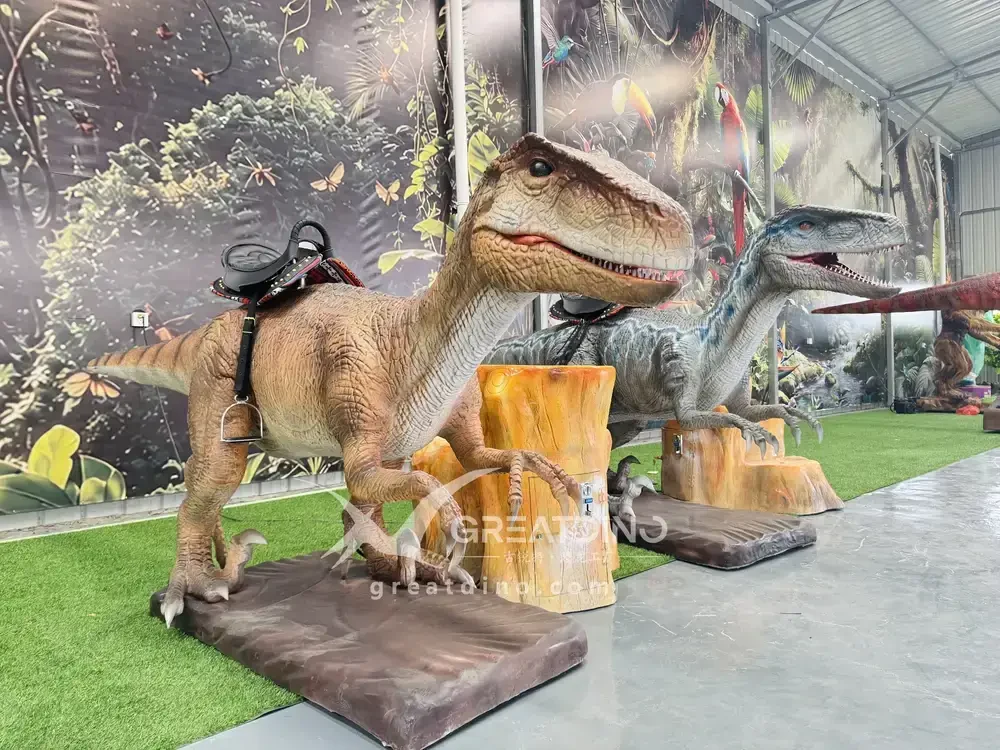
Dinosaur rides look like the simplest product in the catalogue and are the easiest to get wrong commercially. A ride is not a display model with a saddle: it carries a moving rider on top of its own movement, which changes the chassis, the drive and the speed ceiling. It is also the only animatronic product in this industry that a venue expects to earn money per go.
This guide covers what decides a ride specification — rider size, cycle length, control method, floor and power — and the numbers a venue should calculate before ordering, rather than after the first month of takings.
What makes a ride different from a display model
| Display model | Ride | |
|---|---|---|
| Load | Its own weight | Its own weight plus a rider, moving |
| Structure | Frame sized for skin and drive mounts | Load-bearing chassis under the saddle, with footrests and grab points |
| Motion | Programmed show cycle | Short repeating cycle, gentle enough to keep a child seated |
| Control | Timer, remote or sensor | Coin, card or attendant start; fixed cycle length |
| Safety | Barrier and clearance | Barrier, speed limit, seat restraint, supervised boarding |
| Warranty (typical) | 2 years | 6 months — it is a load-bearing machine, not a display piece |
That last row explains why a ride is not simply a cheaper version of a dinosaur. The engineering is different, the load case is different, and the maintenance regime is written around moving parts under a child.
Specify by rider, not by dinosaur
The animal is the marketing; the rider is the specification. Four numbers decide the build:
- Rider age and weight band. A 3 m raptor carrying a four-year-old at 18 kg is a different machine from one carrying a ten-year-old at 40 kg. State the maximum, and the venue should enforce it at the gate.
- Seat height and footrest position. Boots must reach the rests with the knee slightly bent. A ride that cannot be sat comfortably is a ride that gets refunds.
- Cycle length. 60–120 seconds is the usual band. Short cycles raise throughput but feel like a rip-off; long cycles build a queue that blocks the aisle.
- Boarding method. Step-up plinth or ground-level mount. Plinths are safer and read better, but they need a larger footprint and a handhold.
| Venue | Ride length that works | Why |
|---|---|---|
| Mall concourse | 60–90 s | Aisle traffic; long queues block shops and draw security |
| Family entertainment centre | 90–120 s | Paid by card, integrated with other attractions, staff present |
| Zoo or park trail | 90–120 s | Outdoor, seasonal, weather-dependent; families expect a longer ride |
| Fairs and events | 60–90 s | Throughput dominates; the operator wants turnover, not dwell |

Coin, card or attendant: three control models
The control method decides staffing, revenue tracking and how often the ride is out of service for a jammed coin slot.
| Method | Best for | Watch out for |
|---|---|---|
| Coin / token | Unstaffed malls, small parks, fairs | Coin mechanisms jam with foreign coins and dirt; empty the box daily or the ride stops earning |
| Card / app | Family entertainment centres with an existing payment system | Integration cost can exceed the ride; confirm the protocol before ordering |
| Attendant start | Supervised venues, zoos, events | Needs a person present, but that person also manages the weight limit and the queue |
Ask for the cycle counter. A ride without a counter cannot be reconciled against takings, and takings are how the purchase is justified.
The floor, the footprint and the queue
Rides fail site surveys more often than they fail mechanically. Four measurements:
- Footprint including the barrier. Allow 2.5 × 1.5 m per unit minimum, plus a boarding zone that does not block an aisle.
- Floor loading. A ride plus rider plus dynamic load on a small base is a point load. Upper floors of retail centres need a spreader plate and usually the landlord’s engineer.
- Power position. The cabinet or supply should be off the public side, reachable by staff without stepping over the ride.
- Queue space. A 90-second cycle with two units handles roughly 30–40 riders an hour. If the venue expects 100, the ride is the wrong product.
Revenue arithmetic, roughly
Rides are usually justified on payback rather than on spectacle, so the arithmetic matters more than the dinosaur. A simple model, using placeholders a venue can replace with its own numbers:
| Line | Formula |
|---|---|
| Rides per hour | 3,600 ÷ cycle seconds × number of units × 0.7 (boarding time) |
| Daily riders | Rides per hour × open hours × 0.25 (realistic utilisation) |
| Daily revenue | Daily riders × price per ride |
| Annual revenue | Daily revenue × open days |
| Payback | Purchase price ÷ (annual revenue − maintenance and power) |
Two cautions. A single unit cannot reach the throughput a queue needs, so the second unit usually does more for revenue than a bigger animal. And maintenance is not optional: a ride down for a week in peak season costs the season’s margin, which is why the 6-month warranty period is shorter than a display model’s — it assumes daily inspection.
Safety: the parts that are not negotiable
- Speed ceiling. Set in the controller and not adjustable by staff. A ride that can be “opened up” by an attendant will be.
- Restraint or grab point at the saddle, and footrests that a small foot cannot slip past.
- Barrier that keeps bystanders out of the moving radius, with no gap a child can reach through.
- Emergency stop within reach of the attendant, and a start that requires a deliberate two-step action.
- Written rider limits — age, height, weight — displayed at the boarding point, and enforced.
- Daily pre-open check: cycle once empty, check the saddle and restraints, confirm the stop works.
Regulation differs by country and by whether the device is classed as an amusement ride. Confirm the classification with your local authority before ordering; it changes documentation, inspection intervals and sometimes the design.
Indoor and outdoor builds
The same ride ships in two configurations:
| Indoor | Outdoor | |
|---|---|---|
| Finish | Lighter skin and paint acceptable | Three to four silicone layers, UV-stable pigment |
| Base | Plate on an existing floor, or a low plinth | Anchored pad with drainage |
| Power | Mains with a labelled breaker | Mains plus surge protection; seasonal isolation |
| Weather | Not applicable | Cover or store during the closed season |
| Maintenance | Weekly checks | Weekly checks plus post-rain inspection of the base and cabinet |
Frequently asked questions
What is the maximum rider weight?
It is set per model and stated in the offer — typically in the range of 60–80 kg for a single-seat dinosaur ride. Ask for it in writing and put it on the signage. Overloading is the fastest way to crack a chassis and void a warranty.
Why is the warranty shorter than on a display dinosaur?
Because the load case is different: a ride carries a moving rider every cycle, all day, and its parts wear on a schedule that has nothing to do with a display model standing in a park. Six months is normal for rides, against two years for display animatronics and one year for costumes.
Can one ride serve adults and children?
Only if it was designed for the adult load. Most venues run a child ride and sell the adult experience as a photo opportunity rather than a ride. Mixing the two on one unit means the machine is specified for the heaviest rider, which raises cost and reduces the child’s ride quality.
Do rides need a dedicated attendant?
Coin and card units can run unattended, but someone has to clear jams, wipe the saddle and enforce the limits. In practice every profitable installation has a staff member within sight, even if they are not operating it.
How many rides should a mall buy?
Start with two. One unit cannot board while the other carries, so a single ride converts badly; three or more only makes sense where the queue is proven. Additional units can be ordered as a matched set later if the sculpt is reused.
Tell us the venue, the rider age band and the floor, and we will come back with a ride specification including cycle length, control method and the footprint with the barrier. Send your ride brief, or see the dinosaur ride range for reference models.