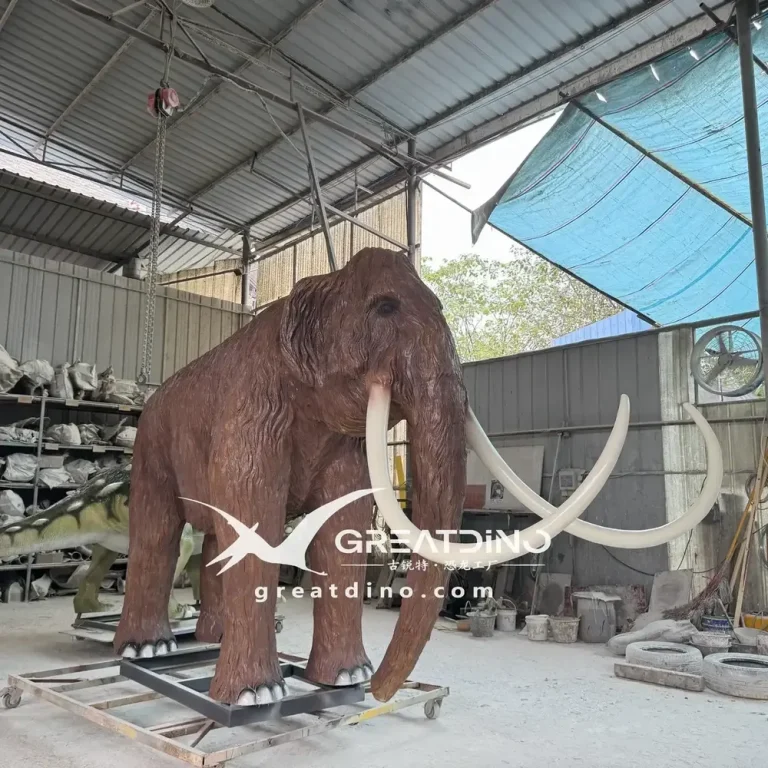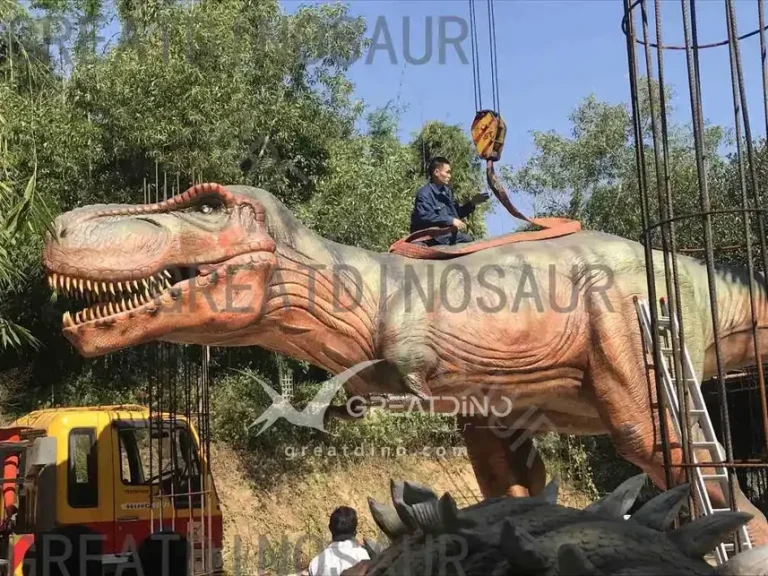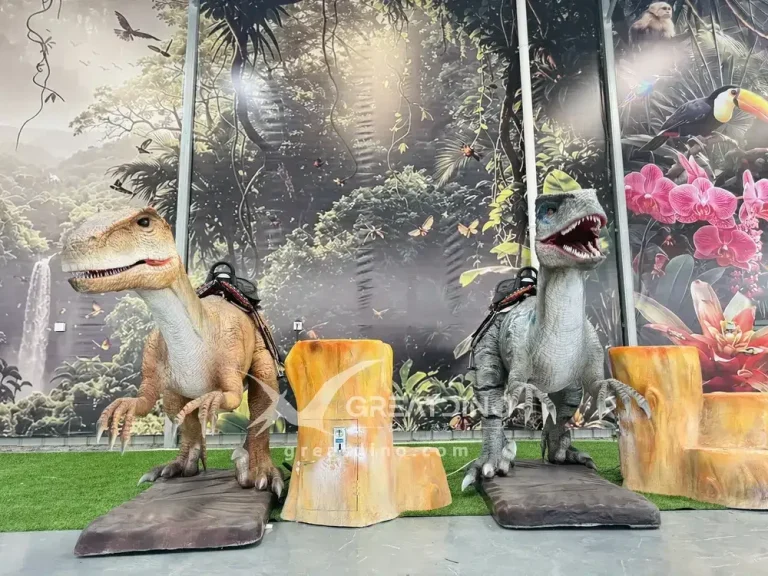
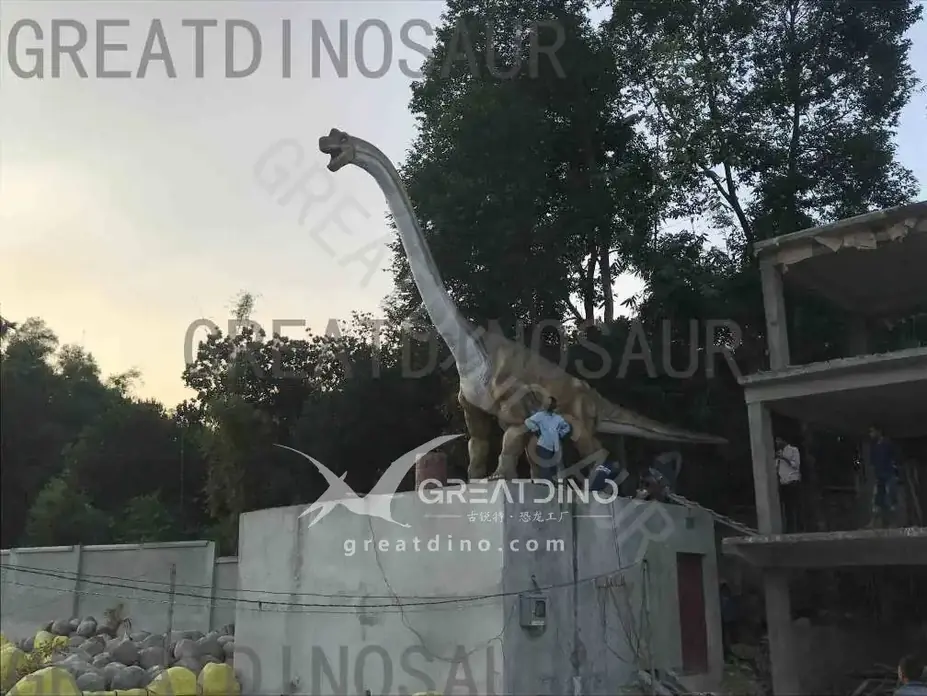
Almost every size disagreement in this business starts with the same sentence: “we want a life-size T-rex”. Life-size compared to what? A tyrannosaurus standing 5 m at the hip is a different purchase from one standing 8 m, and both are sold as life-size. The number that decides the engineering is the standing height at the shoulder and how far the visitor stands from the animal — not the length quoted on a specification sheet.
This guide sets out how size is actually measured, which dimensions drive cost, what each venue type can physically take, and how to write a size into a request for quotation so three suppliers quote the same thing.
Three numbers that get confused with each other
A model has at least four dimensions and buyers usually quote the wrong one. In the workshop the drawing is set from the first two:
| Dimension | How it is measured | Why it matters |
|---|---|---|
| Standing height | Ground to the highest fixed point — usually the hip or the top of the skull in a raised pose | Sets frame loads, ceiling clearance and the visitor’s sightline |
| Body length | Snout to tail tip along the curve, not the straight line | Sets footprint, crate size and container loading |
| Shoulder height | Ground to the top of the shoulder blade | The number that decides whether a child or an adult feels dwarfed |
| Base footprint | The steel base plate or rockery the model stands on | Decides concrete area, anchor count and mowing access |
Manufacturers normally quote “length × height”, in that order, because length drives shipping cost and height drives structure. If a quote gives one number, ask which one it is. A “5 m dinosaur” can mean a 5 m long raptor with a 2.2 m hip, or a 5 m tall brachiosaurus that is 9 m long.
The sizes that actually exist, and what each is for
We build from models small enough to stand on a desk up to 30 m, 40 m and occasionally 50 m segmented pieces. In practice the market concentrates in four bands, and each band solves a different problem.
| Band | Typical use | What it costs you operationally |
|---|---|---|
| 1.5–2.5 m | Indoor exhibits, mall activations, education tables, photo spots | Single-phase power, one person can reposition, fits through a standard double door |
| 3–5 m | The workhorse band: park trails, plaza installations, museum halls | Needs a forklift or crane for unloading; concrete pad or stable paving; dedicated circuit |
| 6–12 m | Entrance monuments, safari drives, hero pieces at a main path | Crane and rigging plan, engineered footings, part-load shipping, two-person maintenance |
| 13 m and above | Landmarks, gate structures, festival centrepieces | Segmented transport, site assembly over several days, structural sign-off, wind analysis |
The jump from 5 m to 12 m is not a 2.4× price. Frame section, skin area, actuator count, shipping volume and installation labour all scale faster than length, which is why a 12 m model often lands at three to four times the price of a 5 m one built to the same standard.

Size is chosen by sightline, not by species
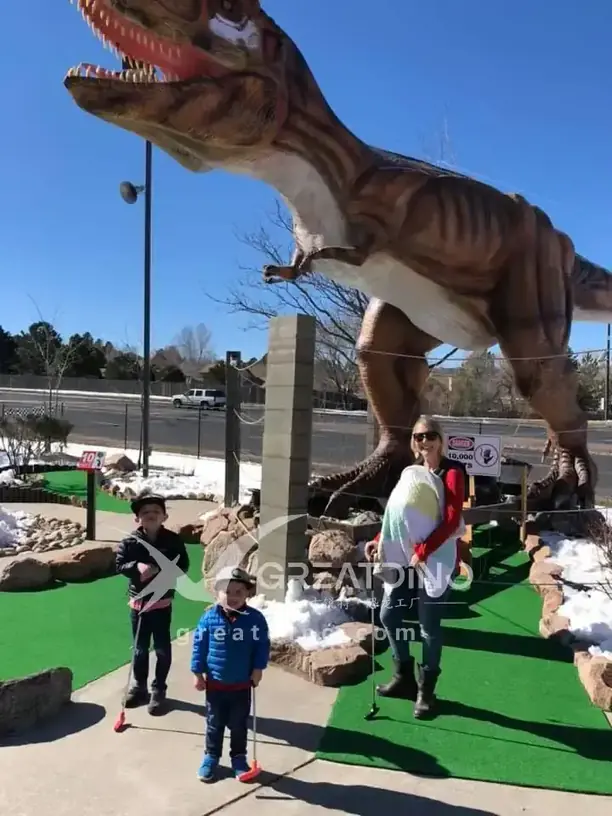
The useful question is not “how big is a triceratops” but “how far away will people stand”. A model seen from 30 m needs mass and silhouette; a model seen from 1 m needs detail and a plausible surface. Same budget, different animal.
| Viewing distance | What the visitor notices | Where to spend |
|---|---|---|
| Under 1.5 m (indoor exhibit, photo prop) | Skin texture, teeth, eye finish, seams | Silicone skin quality, hand painting, eye and mouth detail |
| 3–8 m (park trail, plaza) | Pose and proportion; movement reads as a whole | Silhouette, head size relative to body, two or three well-chosen movements |
| 15–40 m (safari drive, roadside, gate) | Mass and posture only | Height, base treatment, colour contrast against planting |
This is why a 3 m model placed 20 m from the path usually disappoints, while a 12 m model placed 3 m from the path can feel like a wall. Put the viewing distance on the drawing before the size is fixed.
Ceiling, door and turning circle: the indoor limits
Indoor projects fail on logistics far more often than on design. Four measurements decide whether a model can physically get in and work once it is there:
- Door and lift opening. A 2.5 m tall model does not pass a 2.1 m door upright. Ask for the tallest single-piece dimension, then check the freight lift and the corridor width at the tightest corner.
- Finished floor to ceiling, minus 600 mm. A raised head needs clearance for the arc, and lighting rigs usually sit in that space.
- Turning circle for the base. A 12 m model needs a delivery vehicle that can reach the door; a 40 ft container needs 30 m of straight approach.
- Floor loading. A 5 m animatronic with a steel base concentrates load at four anchor points. Upper floors of shopping centres often need a spreader plate, which the landlord will ask about.
Outdoor limits: wind, and what “bigger” costs you
Outdoors, height becomes a wind problem. A 12 m model presents a large sail area, and the base has to take the overturning moment of the local design wind speed, not the average breeze. Two consequences follow:
- Foundations scale with height squared, roughly. A 3 m model can stand on a paving slab with anchor bolts; a 12 m model usually needs a cast footing designed for the site. Getting the footing drawn before the container ships is far cheaper than discovering it on arrival.
- Above about 8 m, consider segmentation. A segmented body ships in sections, assembles on site and can be partially demounted for repair or relocation — useful for touring shows and for venues that lease their land.
Coastal sites add a third: salt attacks fasteners and joints long before it reaches the motor, so the specification changes from “stainless where visible” to “stainless throughout plus sealed joints”, regardless of size.
How to write size into a request for quotation
Three suppliers quoting “a 6 m T-rex” will deliver three different animals. This is the wording that makes the numbers comparable:
| Write this | Not this | Because |
|---|---|---|
| “Tyrannosaurus, 6 m body length, 3.2 m standing height, pose as attached sketch” | “6 m T-rex” | Length and height are independent; pose changes both |
| “Indoor, finished ceiling 4.2 m, door opening 2.4 × 2.6 m, freight lift 2.2 m” | “indoor mall” | Decides whether the model ships in one piece |
| “Viewing distance 4–10 m from a fenced path” | “for a park” | Sets the detail level worth paying for |
| “Outdoor, design wind 32 m/s, coastal, 0–40 °C” | “outdoor” | Sets footings, coatings, fasteners and IP rating |
| “Ground: existing concrete slab, 150 mm, unknown reinforcement” | “flat ground” | Decides whether a new footing is needed |
If the site survey is not done yet, say so and ask for the model on a transport base — most suppliers will quote a base plate that can be anchored to a new pad later, and that keeps the first quote honest.
Five sizing mistakes worth avoiding
- Buying length when you needed height. A long low model disappears behind planting; a shorter tall one dominates. Decide what the visitor should feel first.
- Filling the space. A 12 m model in a 15 m courtyard leaves no room for the queue, the photo angle or the maintenance access. Leave 2 m clear around the base.
- Forgetting the crate. A 6 m model ships in a crate roughly 7 m long. Check that the site gate and the last 200 m of road take a 40 ft container or a flatbed.
- Scaling up a small design. Proportions do not scale linearly; legs and necks need re-engineering above 8 m, and a scaled drawing that ignores this produces a model that looks wrong at full size.
- Ordering the biggest hero piece first. Most parks get more visitors per dollar from five mid-size models along a trail than from one landmark. Size is a distribution decision, not a prestige one.
Frequently asked questions
What is the most common size ordered?
Between 3 m and 5 m body length. It is the band where shipping is still conventional, installation needs no crane in many cases, and the model reads clearly from a park path. Above 6 m the engineering and logistics step up sharply.
Is “life-size” a real standard?
No. Published estimates for many species vary by 20–30%, and pose changes the height independently of the skeleton. Treat life-size as a marketing word and specify standing height and body length in metres instead.
Can a model be made smaller to fit a budget?
Usually yes, down to about 3 m without redesign. Below that, detail work (eyes, teeth, skin texture) becomes a larger share of the cost, so the saving per metre shrinks. If the budget is fixed, reducing the actuator count often saves more than reducing size.
How tall can a model be indoors?
As tall as the ceiling allows minus about 600 mm for the head arc and lighting. Most indoor installs stay under 4 m finished height; above that, the freight and the fire-escape clearance usually become the constraint rather than the model.
Does a bigger model need a bigger power supply?
Only partly. Power follows the actuator count and drive type, not the length. A 12 m model with four movements can draw less than a 4 m model with eight servo axes. Ask for the connected load in kW and the recommended breaker size, then check it against the site.
If you have a site plan and a rough idea of the animal, send the plan with the viewing distance marked. We will come back with two or three size options that fit the space, the power available and the budget, with the base and footing requirements for each. Send your site details, or see the animatronic dinosaur range for reference dimensions.