Every dinosaur budget gets split between two kinds of product: something that moves, and something that does not. The instinct is to buy movement, because movement is what visitors photograph. That instinct is usually right for one or two pieces per site and wrong for the other eight.
This guide compares the two builds honestly — what each costs, what each needs on site, what fails, and how to divide a budget between them so the finished trail looks deliberate rather than under-funded.
The two products, described precisely
The words are used loosely in catalogues, so start with the structure:
| Static model | Animatronic model | |
|---|---|---|
| Structure | Fibreglass or resin shell over a steel armature | Silicone or fabric skin over a steel frame carrying drive mounts |
| Movement | None | Programmed joints — jaw, neck, limbs, tail, breathing |
| Power on site | Not required | Dedicated circuit per unit; control cabinet nearby |
| Staffing | None beyond cleaning | Someone to start, stop and report faults; a technician for drives |
| Weather exposure | Topcoat and gelcoat handle sun and rain | Same exterior, plus sealed joints and protected actuators |
| Service life in a park | Eight to fifteen years with repainting | Six to ten years with maintenance; drives and skin are the variables |
The important difference is not movement. It is that an animatronic model is a machine with a maintenance obligation, while a static model is furniture. That single distinction decides where each belongs.
What each one actually costs — in the right units
Comparing sticker prices is misleading, because the two products fail differently. Compare total cost over five years instead, and normalise by the thing the visitor experiences: a photo, a stop on the trail, a reason to walk further.
| Cost line | Static | Animatronic |
|---|---|---|
| Purchase | Base | Typically 1.8–3× a static model of the same size |
| Site works | Pad or footing | Footing plus power run, breaker, control position |
| Installation | Bolt down, touch up | Assembly, power connection, program test, operator briefing |
| Annual upkeep | Clean and inspect; repaint every 3–5 years | Skin repair, joint checks, drive and cable inspection, spares |
| Downtime risk | Essentially none | Real: a failed drive takes the unit off show until replaced |
| Visitor effect | Photogenic, silent, predictable | Draws a crowd, holds attention, generates video |
On that basis the two are not competitors. A static model is the cheapest way to fill a trail with credible animals. An animatronic model is the most effective way to create one or two moments that people stop for.

Where static models win outright
- Long trails with many stops. Twelve animals along 800 m at a fixed budget: static gets you twelve, animatronic gets you four. Visitors count animals, not actuators.
- Remote or unpowered ground. A site where running cable costs more than the model: riverbanks, forest walks, roadside verges, rooftop gardens.
- High-touch, high-risk positions. Where visitors will climb, lean or let children hang off a tail. A mechanism is a liability in that spot; a solid sculpture is not.
- Sites with no maintenance team. A municipal park with one gardener should not own six servo systems.
- Background and depth. Distant silhouettes behind the hero piece cost little and make the scene read as a herd.
Where animatronic wins outright
- The one thing people came for. The gate piece, the arena show, the exhibit a school books. Movement is the reason the ticket exists.
- Indoor halls with controlled conditions. Less weather, stable power, staff on site — the environment that suits machinery best.
- Programmed shows. A timed sequence with sound turns a model into an event that fills a seating area every 30 minutes.
- Interactive exhibits. Motion sensors and triggers convert a display into an activity, which is what science centres and family attractions are actually selling.
- Marketing assets. Video of a moving animal travels further than a photograph of a still one, and travel is free reach.
The mix that works: a 60/40 rule of thumb
Across park projects we see a pattern that holds up: roughly 60% of units static, 40% of budget animatronic. Stated as a plan, it looks like this:
| Position on site | Build | Why |
|---|---|---|
| Entrance / gate monument | Animatronic, large | First impression and the photo everyone takes |
| Main path, every 40–60 m | Static, mixed species | Pace and density for very little money |
| Mid-trail hero clearing | Animatronic, programmed | The stop where the group spends ten minutes |
| Secondary trails | Static, larger silhouettes | Depth without maintenance load |
| Indoor exhibit / education room | Animatronic, interactive | Controlled environment, staff present, triggers work |
| Photo point | Static with a designed pose | Predictable framing; no motion blur, no queue stall |
One caveat: do not put a static model directly beside an animatronic one on the same path unless the difference is intentional and explained. Visitors read the pair as “one broken, one working”. Separate them by a bend, planting or 30 m of trail.
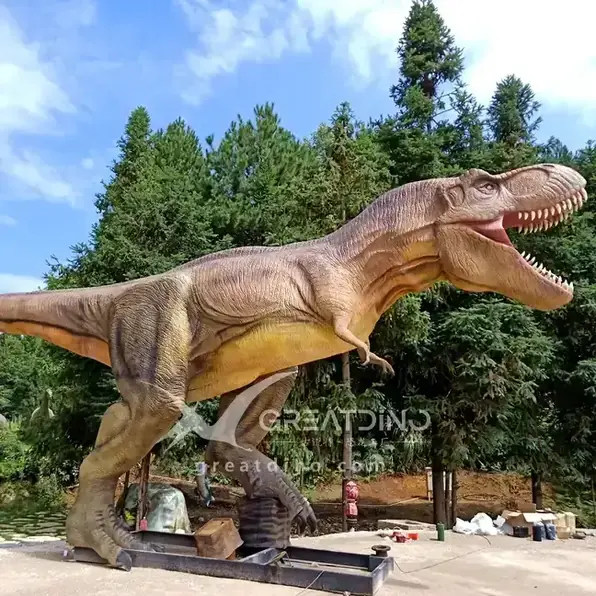
Converting one into the other: usually a bad trade
Buyers often ask whether a static model can be animated later. Technically the answer is “only by rebuilding it”, and it is worth understanding why:
- The armature in a static piece is designed to hold a shape, not to carry drive mounts, cable routes and the reaction force of a moving joint.
- The shell is thin and rigid; an animatronic skin has to flex at every joint without splitting, so it is a different material and a different thickness.
- There is no control cabinet, no cable path and no provision for the power the site has not run yet.
If animation is likely within three years, specify the animatronic frame now and finish it as a static piece — the extra cost is in the frame, not in the mechanism, and the upgrade path stays open.
Seven questions that settle the choice
- Is there power within 3 m of the position? If not, price the cable run before choosing.
- Who will service it, and how far away do they live? A model four hours from the nearest technician is effectively static after year two.
- Will visitors touch it? Touch pushes you toward static, or toward an animatronic behind a barrier.
- Is the site rented? Leased land favours static, or segmented animatronic that can be demounted and moved.
- Is the position seen from under 2 m or over 20 m? Close viewing rewards animation; distant viewing rewards silhouette and size.
- Does the marketing plan need video? If the campaign depends on motion, budget for one animated piece rather than six still ones.
- What happens in the wet season? Animatronic units need drainage and regular joint checks; static units need a topcoat that resists standing water at the base.
Frequently asked questions
Can a static dinosaur be made to look as realistic as an animatronic one?
Yes, and sometimes more so, because the budget that would have gone into mechanisms goes into sculpt, skin detail and paint. The limitation is not realism, it is attention: a still animal stops holding a crowd after about thirty seconds.
Do animatronic models cost much more to maintain each year?
Budget roughly 3–6% of the purchase price annually for inspection, skin repair and the occasional drive or valve replacement, plus a small spares stock. Static models need cleaning and a repaint every three to five years, which is far less but not zero.
Which is better for a coastal site?
Static is lower risk, because there are no actuators or control cabinets to corrode. If you want movement on a coastal site, specify stainless fasteners, sealed joints, an IP-rated cabinet and a maintenance interval of three months rather than six.
Can the two be mixed in one scene?
Yes, if they are separated enough that the comparison is not immediate — different clearings, different trail sections, or a static model placed as background behind the animated hero. Side by side at the same scale invites the “broken one” reading.
What size static model gives the best value?
Three to five metres. Below that the sculpt and paint work dominate the price; above that shipping and installation climb faster than the visual gain, unless the piece is a deliberate landmark.
If you are dividing a budget now, send the site plan and the opening date. We will propose a mix with the split written down — how many static, how many animated, and what each one needs on site — so the decision is comparable rather than emotional. Send your project details, or compare the fiberglass statue range with the animatronic dinosaur range.