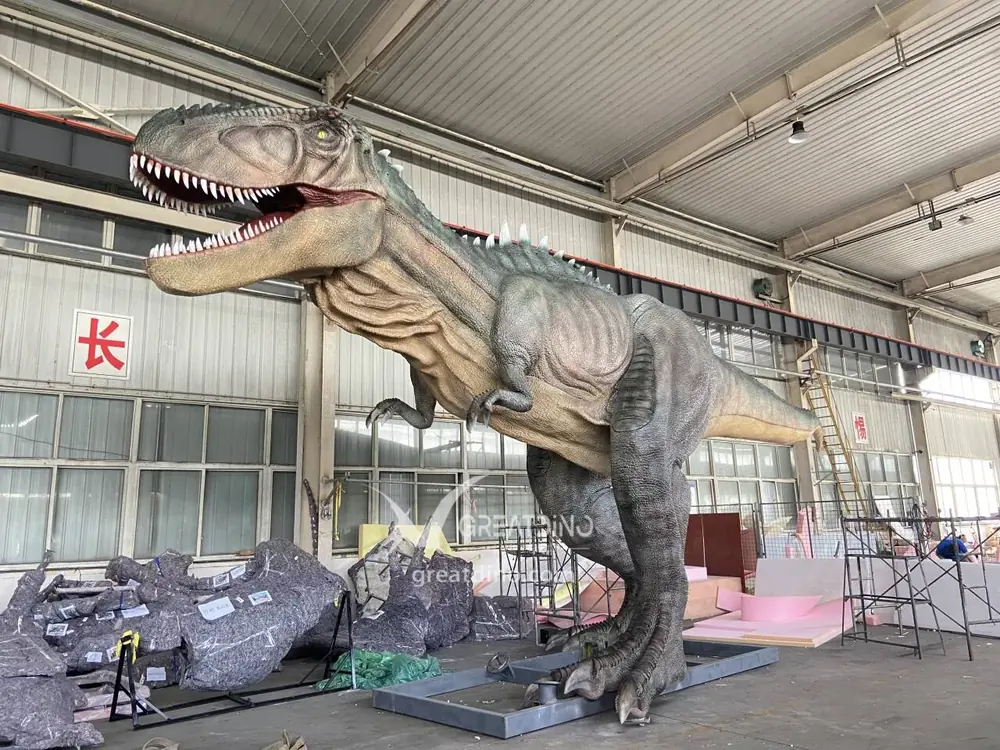
Buyers use “mechanical dinosaur” and “animatronic dinosaur” as if the two mean the same thing. In a quotation they do not. Behind the labels sit different drive systems, and the drive system decides how a model moves, what fails first, and how much of your maintenance budget disappears into it by year five.
This guide separates the four drive types in use today, shows what each one can and cannot do, and ends with the eight parameters to put into a request for quotation so that the numbers coming back are actually comparable.
Why the two terms are not interchangeable
Strictly speaking, mechanical covers any model whose movement comes from machinery: pneumatic cylinders, DC motors, cams, linkages. Animatronic is narrower — a model driven by electric actuators under electronic control, normally servo motors running programmed sequences.
In practice the words are used loosely. A catalogue may call a pneumatic neck “mechanical” and a servo-driven head “animatronic” when both were assembled in the same workshop. For a buyer the label matters less than three answers:
- What produces the movement?
- How precisely can it stop, hold and repeat?
- What wears out first, and can your own staff replace it?
The four systems below are what you will actually be quoted for.
The four drive systems you will be quoted for
| System | What moves the model | Motion range | Where it fits |
|---|---|---|---|
| Static | Nothing — fibreglass or resin shell over a frame | None | Entrance monuments, photo props, background scenery |
| Pneumatic | Air cylinders fed by a compressor | Two positions only | Scene-setting models, high unit counts, budget-driven parks |
| DC motor | Electric motor through a worm reducer | Continuous, speed adjustable | Mid-budget parks, touring shows |
| Servo | Encoder servo motors on each axis | Any position, programmable | Museums, science centres, show parks |
Pneumatic
Compressed air pushes a piston. It is cheap, powerful and tolerant of rough handling, which is why it still dominates large outdoor scenes. The trade-off is motion quality: a cylinder is either out or in. It cannot stop halfway, it cannot slow down before it stops, and the exhaust is loud. It also needs a compressor on site, and in humid climates that compressor puts water into the lines unless the air is dried.
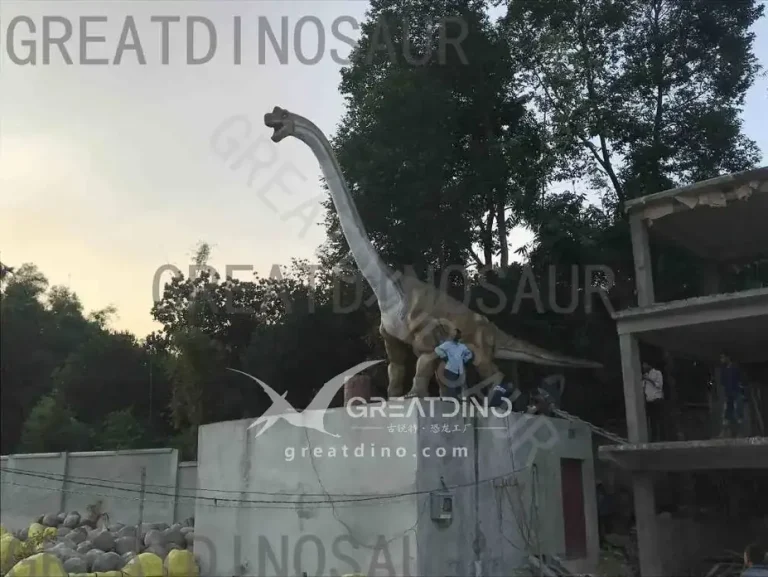
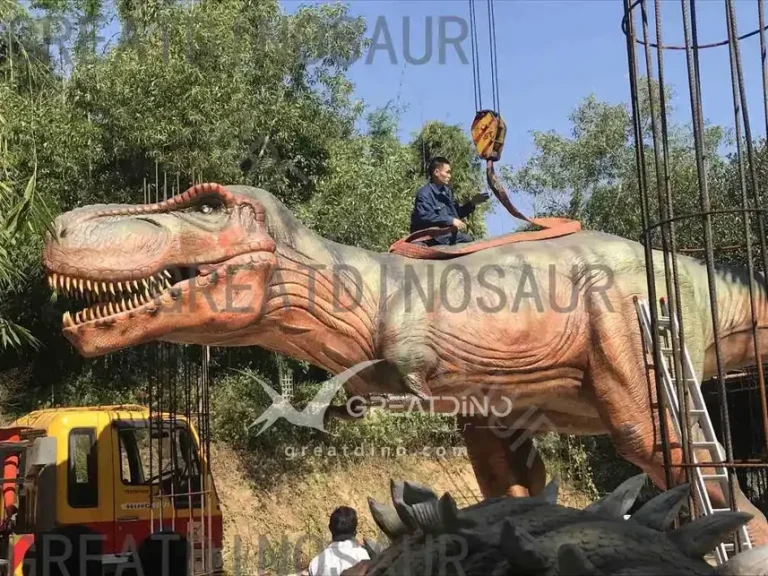
Choose it when the model is scenery rather than a performance — a roaring jaw on a 12 m tyrannosaurus, a tail that swings on a timer, a herd where forty units matter more than forty programs.
DC motor with worm reducer
An electric motor turns a geared shaft. Movement is continuous and reversible, speed can be trimmed with a controller, and the parts are ordinary industrial components that any maintenance team can source locally. Positioning depends on limit switches, so the model repeats roughly rather than exactly, and the motion keeps a mechanical rhythm.
Choose it when the model needs to look alive without needing choreography — a head that turns slowly across a path, a neck that rises and falls.
Servo
A servo motor carries an encoder, so the controller knows the shaft angle at all times and can command any point in its travel. Movement ramps up, holds and settles. Several axes can be synchronised, so a jaw opens while the neck dips. Operation is quiet, which matters when visitors stand a metre away.
The cost sits in the electronics rather than the mechanics: drives, cabling and programming time. Servo systems also dislike unstable voltage, so a site with a weak supply needs a stabiliser before the models arrive.
Choose it when the exhibit is the attraction rather than part of the scenery — a museum hall, a science centre, a park that runs a scheduled show.
Hybrid
Most models above 8 m end up hybrid, because the economics stop being uniform across the body. A common split is servo for the neck and jaw, where visitors look closely, and pneumatic or DC for the tail and limbs, where the movement is broad and nobody inspects the joint. A hybrid quote is not a compromise; for a large animal it is usually the correct answer, and it should be written down axis by axis rather than described as “mixed”.
Side by side: what actually differs
| Pneumatic | DC motor | Servo | |
|---|---|---|---|
| Positioning | Two positions | Set by limit switches, repeats approximately | Any angle, repeats exactly |
| Noise in operation | High — air exhaust | Medium — gearbox | Low |
| Motion feel | Fast, hard stop | Steady, mechanical | Ramped, can hold and settle |
| Programmed sequences | No | Limited | Yes, multi-axis synchronised |
| First failure we see | Cylinder seal, solenoid valve, water in the line | Brushes, gearbox oil, limit switch | Drive fault, encoder cable, lost parameters |
| Site-repairable | Partly | Yes | Needs a trained technician |
| Relative unit cost | Low | Medium | High |
Match the system to the venue, not to the brochure
The same model can be built three ways at three prices. What decides the right one is not the dinosaur; it is where the dinosaur stands and who stands next to it.
| Venue | Recommended drive | Why |
|---|---|---|
| Outdoor theme park, many units | Pneumatic or DC | Unit cost and simple servicing dominate; visitors stay three to five metres back, so fine motion is wasted |
| Museum or science centre | Servo | Visitors come within a metre; noise and smooth motion matter more than unit price |
| Indoor mall or family centre | Servo or quiet DC | Noise limits and ceiling height rule out compressors and tall poses |
| Touring exhibition | DC with modular joints | Repeated disassembly punishes fragile parts and long cable runs |
| Coastal or high-humidity site | Any, with stainless fasteners and sealed joints | Salt spray attacks linkages and fasteners long before it reaches the drive |
| Desert or high-dust site | Sealed DC or servo | Dust destroys open pneumatic circuits and clogs filters |
Where the money goes after year one
The purchase order is not the cost. What separates a model still running in year six from one quietly switched off in year three is how the joints were specified and what spares were ordered with the container.
| Drive | Typical first failure | Inspection | Spares worth stocking |
|---|---|---|---|
| Pneumatic | Cylinder seal, solenoid valve | Drain the filter monthly; check seals every six months | Seal kit, solenoid valve, filter element |
| DC motor | Carbon brushes, gearbox oil, limit switch | Brushes every 12–18 months of daily use | Brush set, limit switch, gear oil |
| Servo | Drive fault, encoder cable | Cable and connector check every six months | One spare drive, a copy of the parameters |
Three documents are worth writing into the contract, because they cost the supplier very little and save you weeks:
- A spare parts list with part numbers, not a photo of a box.
- A backup of the control program and parameters, on a USB stick that ships with the model.
- A wiring diagram showing which cable feeds which axis.
Without the third one, a fault in year two turns into a video call, a guess and a week of downtime. With it, your own electrician can trace the problem in an afternoon.
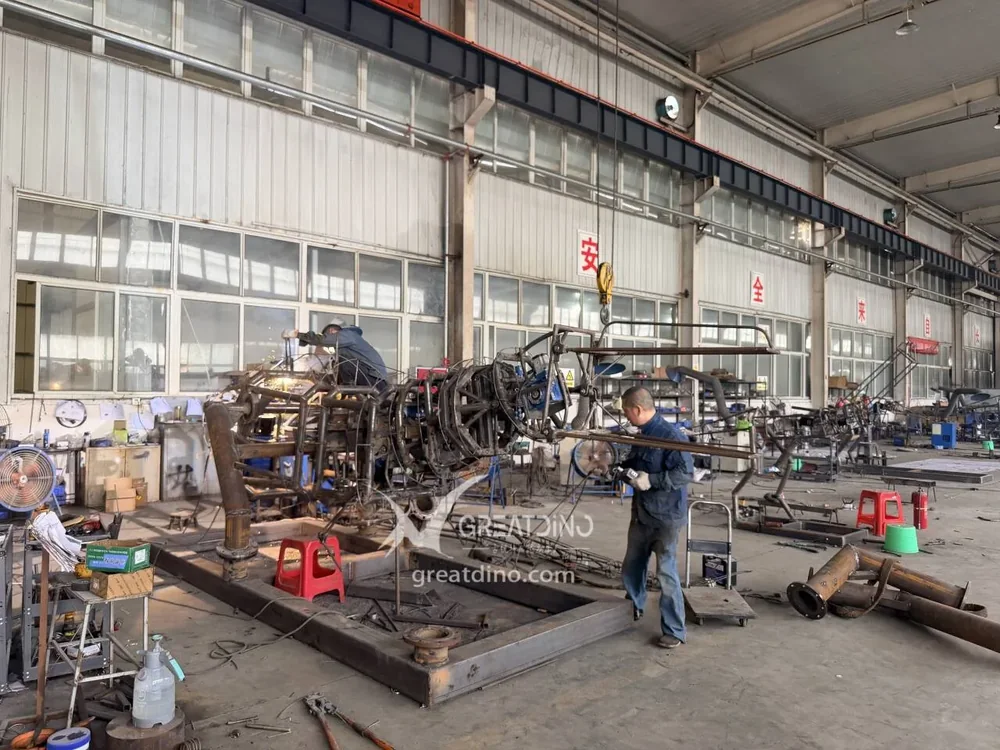
Power, climate and civil works
Most failures blamed on the model are site problems. Four things decide whether a delivery works on day one:
- Supply stability. Servo drives fault on voltage dips. If the site runs on a generator or sits at the end of a long line, specify a stabiliser as part of the package.
- Dedicated circuits. Each model should have its own breaker with earth leakage protection, sized from the actuator count rather than from the model’s length.
- Foundations. A 6 m model with a moving neck produces load at the base that a paving slab will not take. Concrete footings and cast-in bolts are far cheaper before the container arrives.
- Drainage and airflow. Models set into planting collect water in the base. A 30 mm drain and 100 mm of clearance under the frame prevents the most common corrosion complaint.
On coastal installs we specify stainless fasteners and seal every joint regardless of drive type, because salt reaches the hardware long before it reaches the motor.
Eight parameters that make quotes comparable
Most quotation problems are not price problems. They are specification problems: three suppliers quote three different products and the numbers cannot be lined up. These eight lines close that gap.
| Parameter | Why it has to be in the RFQ | Wording to avoid | Wording that works |
|---|---|---|---|
| Species and standing height | Frame and skin scale with size | “large dinosaur” | “tyrannosaurus, 5 m standing height, 9 m long” |
| Motion list | Actuator count drives most of the cost | “realistic movements” | “jaw, neck left-right, tail sway, breathing, eye blink” |
| Drive type | Otherwise each quote assumes a different system | (left blank) | “servo neck and jaw, pneumatic tail” |
| Control method | Changes sensor and wiring cost | “remote control” | “wireless remote plus motion sensor, three timed programmes” |
| Environment | Sets IP rating, coatings and fasteners | “outdoor” | “outdoor, coastal, 0–40 °C, salt spray exposure” |
| Power supply | Decides compressor versus servo | “standard voltage” | “220 V single phase, 50 Hz, dedicated 16 A circuit” |
| Skin and finish | Largest hidden difference between quotes | “realistic skin” | “silicone skin, UV-stable pigment, flame-retardant additive” |
| Delivery scope | Installation is often excluded by default | “supply model” | “supply, pack, ship to port, installation by your team on site” |

Four mistakes that appear in almost every first order
- Comparing total price instead of motion list. A quote that is 30% cheaper usually has 30% fewer actuators. Ask for the axis list next to the price.
- Leaving the drive type to the supplier. Left blank, the answer is whatever is cheapest to build, not what suits the venue.
- Placing the model too close to a wall or path. Serviced joints need access. A model 300 mm from a fence cannot be maintained without dismantling it.
- No program backup. Servo systems are reliable until a drive is replaced; without the parameter file, the replacement has to be re-tuned on site by someone who has flown in.
Frequently asked questions
Is a mechanical dinosaur the same as an animatronic dinosaur?
No. Mechanical is the broader term for any model moved by machinery, including pneumatics and simple motors. Animatronic specifically means electric actuators under electronic control, usually servo motors running programmed sequences. In catalogues the words are often mixed, so ask what drives each axis rather than which word is on the page.
Which costs less to run over five years, pneumatic or servo?
Pneumatic is cheaper to buy and cheaper per spare part, but it adds compressor maintenance, condensate draining and higher energy use. Servo costs more up front and needs a trained technician for repairs, yet it has fewer wear parts and no air system to maintain. For a site with daily operation and no in-house technician, servo often wins on total cost despite the higher invoice.
Can a pneumatic model be upgraded to servo later?
Rarely worth it. The frame usually lacks the mounting points for servo drives, the wiring is sized for solenoids, and the skin has to come off. Upgrading one axis is possible; converting a whole model is close to rebuilding it. If servo is likely in year three, specify the frame for it now.
Do animatronic dinosaurs work in coastal or desert climates?
Yes, with the right build. Coastal sites need stainless fasteners, sealed joints and a UV-stable topcoat. Desert sites need sealed drives and dust-rated filters, and pneumatic systems need dry air. The climate rarely rules out a drive type; it changes the specification around it.
How long does on-site commissioning take?
For a 4–6 m model with four to six axes, plan half a day to two days per unit including mechanical assembly, power connection, program check and a test run with the operator. Large models with more axes or a hybrid drive take longer, and the schedule should be agreed before shipping rather than after arrival.
If you are writing a brief now, send the species list, the venue type and the opening date. We will come back with the axis list, the drive options for each axis, and the site requirements that have to be ready before the container lands. Send your project details or browse the animatronic dinosaur range for reference sizes.