A dinosaur skull is the easiest replica to buy and the easiest to get wrong. The photograph looks right, the price looks reasonable, and then the crate arrives with a piece that will not hang on the wall it was bought for, or a cast whose teeth were moulded as one solid block.
This guide covers the four decisions that determine whether a skull replica works in your space: what “life size” actually refers to, which material suits the placement, how it will be mounted, and what to inspect before it ships.
What “life size” means on a skull
Life size should mean cast from a real specimen, or scaled precisely to one. In practice the number on a quote can refer to three different things: the length from the tip of the premaxilla to the back of the occipital condyle, the length including the neck frill, or the overall height of the piece on its stand. Two suppliers can both say “1.5 m” and deliver pieces that differ by a third.
Ask which measurement the size refers to, and ask for it in writing with a dimensioned drawing.
| Species | Skull length, approximate | Note |
|---|---|---|
| Tyrannosaurus rex | 1.4–1.5 m | Largest specimens; teeth add a few centimetres |
| Triceratops | 1.8–2.2 m | Measured with the neck frill and brow horns |
| Spinosaurus | ~1.7 m | Long and narrow; reads smaller than it measures |
| Stegosaurus | 40–50 cm | Small head relative to a 9 m body |
| Velociraptor | ~25 cm | Study and teaching size |
| Generic teaching cast | 20–30 cm | Scaled, not taken from a specimen |
Cast or sculpt
A cast reproduces an existing specimen, including its asymmetries, healed injuries and missing pieces. A sculpt is modelled from anatomy and can be produced at any size, which is why educational sets come in round numbers like 25 cm or 1 m. Both are legitimate products; they are not the same thing. If the piece is going into a museum gallery next to original material, say so at the quotation stage — it changes what you should be buying.
Material: what you are really choosing
Four materials cover almost every skull replica on the market. The names matter less than two numbers most quotes omit: wall thickness and whether there is an internal frame.
| Material | Detail | Weight | Impact | Outdoor | Best for |
|---|---|---|---|---|---|
| Polyurethane resin | Highest | Light | Brittle | Not recommended | Indoor study and gallery pieces |
| Glass-reinforced plastic (GRP) | Good | Medium | Strong | With UV topcoat | Large display skulls, sheltered outdoor |
| Resin shell over GRP backup | Highest | Medium | Strong | With UV topcoat | Large pieces where surface detail matters |
| Plaster or cement | Low | Very heavy | Low | No | Teaching, local use only |
Two pieces can both be described as “fibreglass” and be different products. A 3 mm shell flexes when lifted and cracks at the jaw hinge; an 8 mm shell with ribs behind the orbit and a steel spine through the braincase behaves like a structure. Ask for the wall thickness and a photograph of the inside of the cast — the inside tells you more than the outside.
The other practical number is weight and centre of gravity. A 1.5 m cast is not a one-person lift, and the fixing has to be chosen for where the mass actually sits, not for the centre of the frame.
Mounting: where quotes quietly fail
Three mounting methods cover most installations, and each one imposes a requirement on the building rather than on the skull.
- Wall mount. A steel back plate fixed with chemical anchors, with the skull carried on a bracket. Cheapest, and entirely dependent on what the wall is made of.
- Floor stand. Single post, twin post or base frame. Independent of the building, takes floor space, and needs the base sized for the piece’s centre of gravity.
- Suspended. Ceiling-hung from a frame. Needs structural sign-off from the building engineer, not from the supplier.
The wall decides the method more often than the design does. Concrete or masonry takes a chemical anchor directly. A stud partition takes a spreader plate, and often a floor stand instead. A glazed or curtain wall takes neither, and the piece moves to a stand.
Ask for three documents: an installation drawing with anchor type, spacing and torque; the centre of gravity; and the lifting points. Without the third, the rigging crew guesses, and a cast that lands on one corner is a cast you will be repairing.
Inspecting a cast before it ships
Most quality problems are visible in the factory and invisible in a photograph taken from three metres away. Six checks catch nearly all of them.
- Mould parting line. A line across the snout or through the orbit means the seam was not dressed. Ask for a close photograph of the seam area.
- Teeth. Individually cast teeth can be replaced when one chips. Teeth moulded as a single block cannot, and that block is usually the first thing to break in transit.
- Openings. The antorbital fenestra and the nares should be open through the cast. If there is solid material behind them, the piece is a shallow shell with painted depth.
- Surface texture. Real bone carries suture lines, foramina and vessel grooves. A cast that is smooth everywhere has been over-sanded or over-filled.
- Colour consistency. If you ordered a set, ask for one photograph with all pieces in the same frame. Two pieces finished in different sessions rarely match.
- Trial fit. The bracket and the skull should be assembled once in the factory. A hole drilled on site is usually a hole in the wrong place.
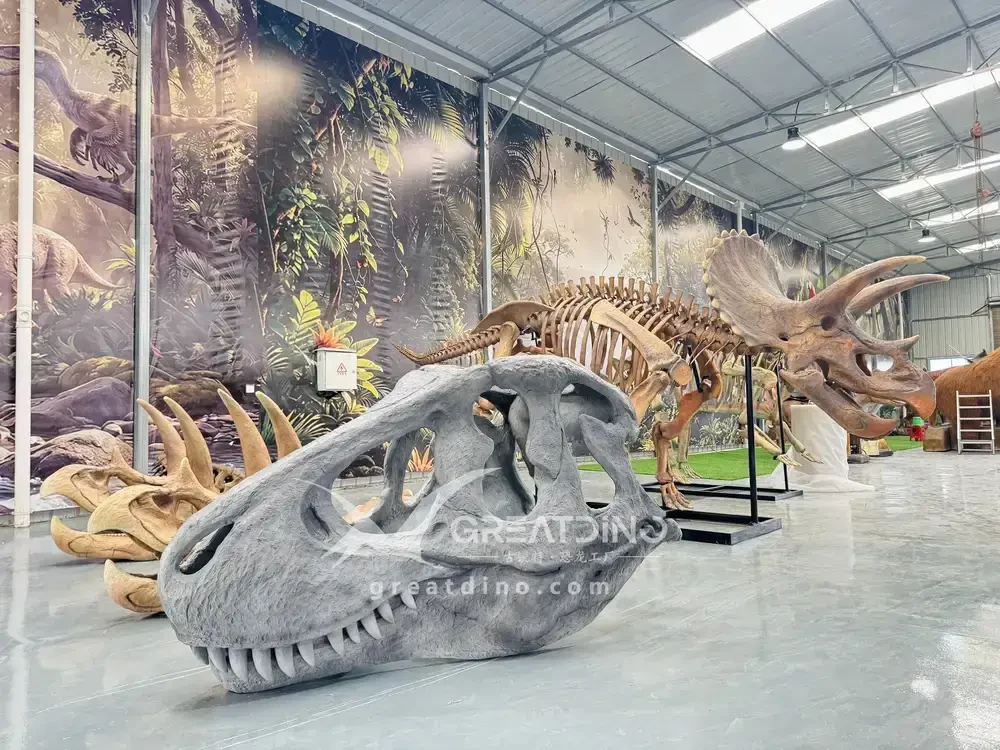
Ask for a video walk-around and caliper photographs of the stated dimensions, not just a wide shot. It takes the supplier twenty minutes and removes most of the argument later.
Indoor, sheltered and full outdoor
| Placement | Material | Additional treatment |
|---|---|---|
| Indoor, climate controlled | Resin or GRP | None; keep resin out of direct sun |
| Sheltered outdoor, under canopy | GRP | UV-stable topcoat, sealed base |
| Full outdoor | GRP with internal frame | UV topcoat, drainage holes, stainless fixings |
| Touch or photo area | GRP | Sacrificial clear coat, annual inspection |
Temperature matters more than rain. A large GRP piece fixed rigidly at both ends will develop stress cracks through a 30 °C annual swing. Slotted fixings cost almost nothing and absorb the movement.
Skull replica or full skeleton?
Buyers often start with a skeleton and end up with a skull, or the reverse. The choice is about the room, not the budget.
| Skull replica | Full skeleton replica | |
|---|---|---|
| Space needed | A wall, a plinth or about 1 m² of floor | 6–12 m of floor and clear height |
| Visitor distance | Close — detail is the point | Three metres or more |
| Installation | One day, two people | Frame assembly, rigging, several days |
| Best placement | Gallery walls, reception, teaching rooms | Atriums, entrance halls, outdoor plazas |
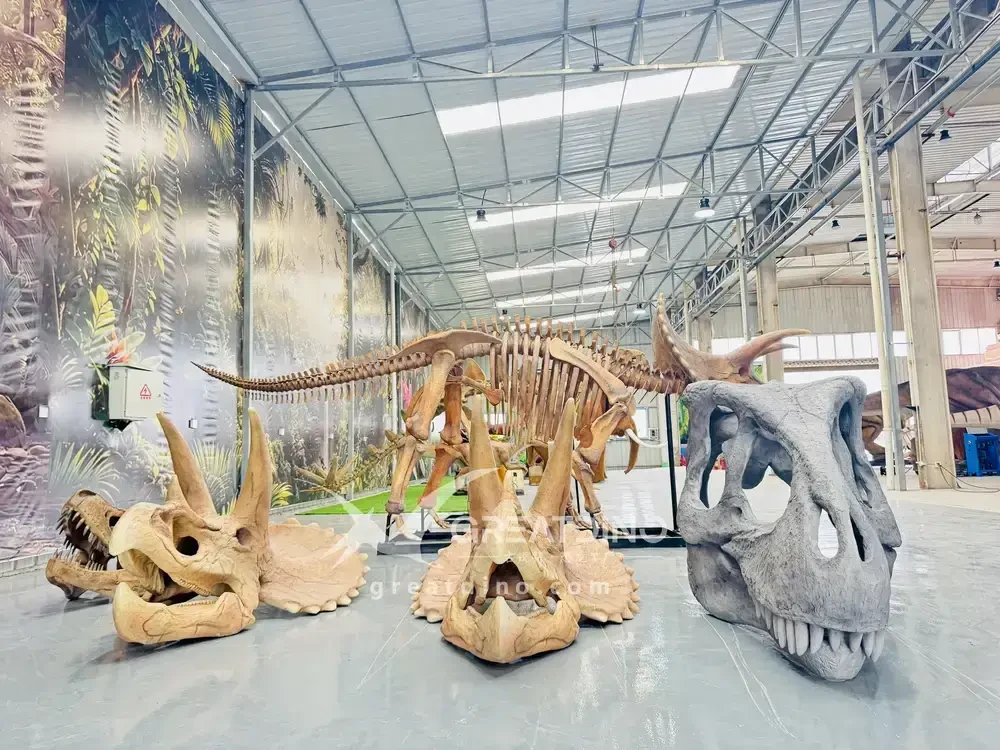
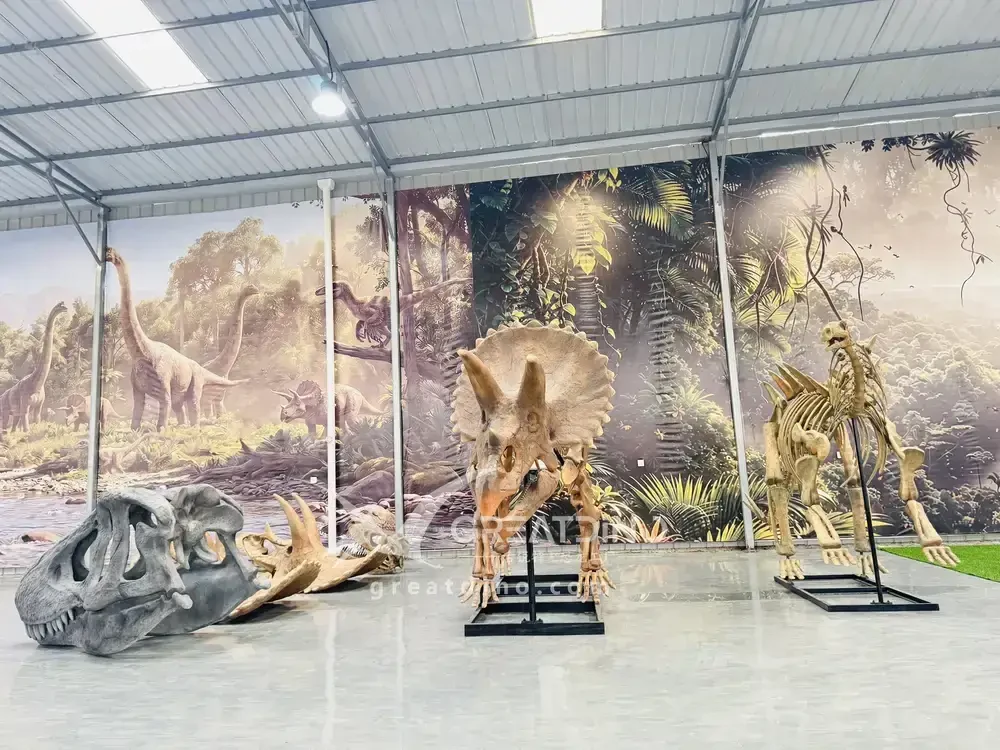
If a skeleton is the eventual plan, order the skull first and confirm that the scale and finish match. Mixing a skull from one supplier with a skeleton from another is how galleries end up with two slightly different bone colours under the same light. Our skeleton and fossil replica range shows the two formats side by side, including a triceratops skeleton and a stegosaurus skeleton cast at the same scale.
Seven lines to compare across three quotes
| Line | What to check |
|---|---|
| Size and measuring basis | Which dimension, measured from where, with a drawing |
| Material and wall thickness | Named material plus millimetres, not just “fibreglass” |
| Internal frame | Present or not, and how it attaches to the mount |
| Mount and anchors | Included or excluded; anchor type specified for your wall |
| Finish | Colour reference and whether pieces are finished as a set |
| Packing | Crate type, foam, and whether the jaw is braced separately |
| Installation support | Drawing only, video call, or attendance on site |
Frequently asked questions
How accurate is a dinosaur skull replica compared with the original?
A cast taken from a museum specimen can be accurate to the millimetre on external form, because it comes off the same surface. A sculpt is anatomically informed but interpretive. Ask whether the piece is a cast or a sculpt, and from which specimen if it is a cast — that answer is more useful than an accuracy percentage.
Can a skull replica be displayed outdoors?
Yes, in glass-reinforced plastic with a UV-stable topcoat and sealed fixings. Resin is not suitable outdoors: it chalks and becomes brittle under UV. Under a canopy the requirements drop sharply, and many sites choose GRP for sheltered positions where a resin piece would have been fine indoors.
What is the difference between a skull replica and a skeleton replica?
A skull replica reproduces the cranium alone and is usually mounted on a wall or a stand. A skeleton replica reproduces the whole animal on an armature and needs floor space, rigging and several days of installation. Skulls suit small spaces and close viewing; skeletons suit atriums and entrances.
How is a large skull shipped without damage?
In a timber crate with the jaw braced, the teeth protected separately, and the piece supported at the points where it will be supported on the wall. Foam alone is not enough for a 1.5 m cast: it needs a cradle shaped to the skull. Ask for photographs of the packing before the crate is closed.
Can a skull replica be scaled up or down?
Scaling works cleanly from a digital model, so a sculpt can be produced at 50% or 150% without much trouble. A cast cannot be scaled after moulding without losing fidelity, so a scaled version is effectively a new sculpt. If the size is critical, fix it before the mould is made.
If you are specifying a skull now, send the species, the placement and the wall or stand you have in mind. We will come back with the measured dimensions, the material that suits the position, and the fixing method the building will actually take. Send the details and we will reply with drawings.