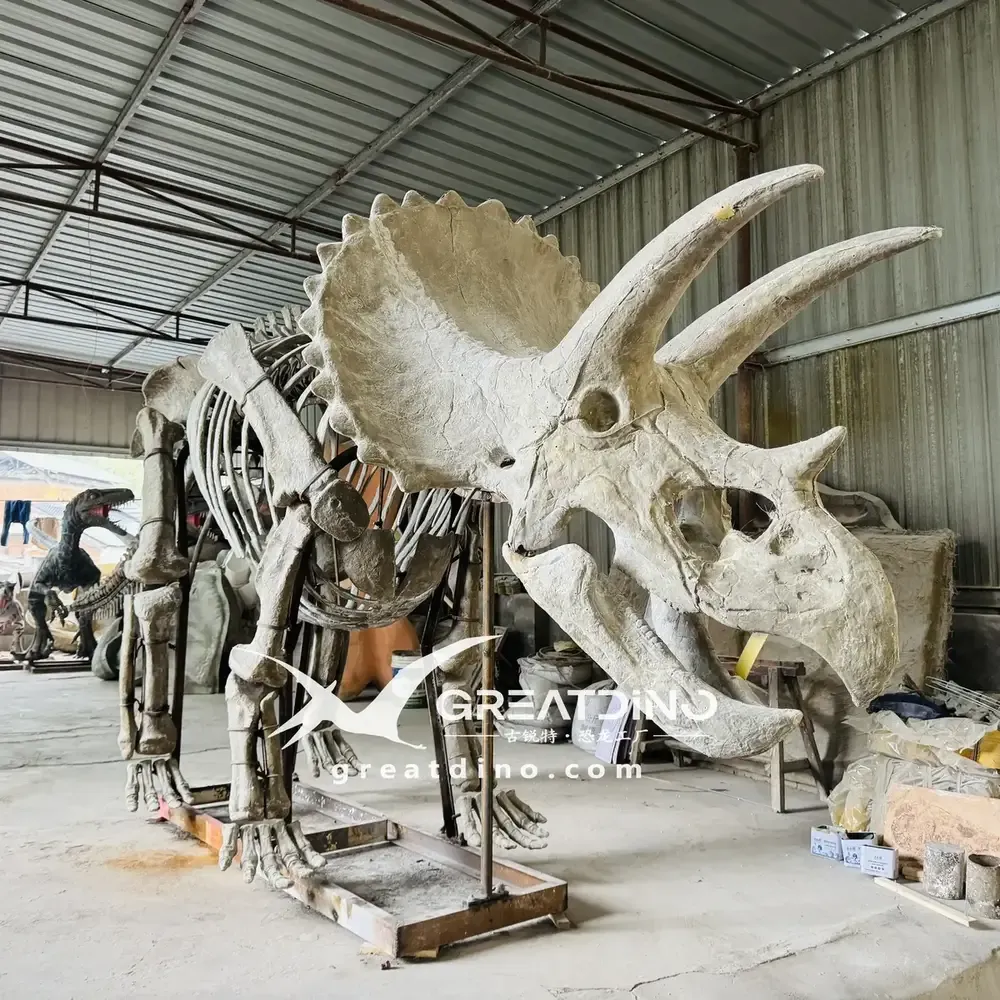
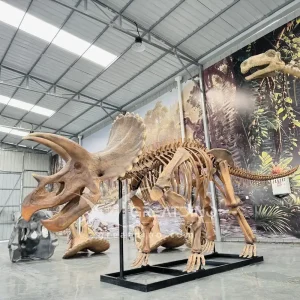
A six-metre Triceratops skeleton with the frill built as a true three-dimensional form and the three horns cast at their real proportion. Mounted on an internal steel armature, shipped in sections, reassembled with a bolted joint system.
Every model is made to order. The figures below describe this build as specified; size, pose, colours and effects are configured around your site before the frame is laid out.
| Product type | Full-size fiberglass dinosaur skeleton replica |
|---|---|
| Overall size | Length 6 m, height approx. 2.6 m at the frill — custom sizing from 3 m to 12 m |
| Power | None required — static exhibit; optional spot lighting by others |
| Structure | Internal steel armature with bolted section joints · freestanding or wall-anchored |
| Materials | Cast fiberglass bones with resin detail · steel armature · powder-coated support frame |
| Detail | Full skull with brow and nasal horns · fenestrated frill · vertebral column · rib cage · girdles and limbs |
| Mounting | Freestanding on a floor frame, or suspended from certified ceiling points |
| Weather rating | Indoor recommended; outdoor installation available with UV-stable finish and sealed armature |
| Lead time | 40–55 days after drawing approval |
| Warranty | 2 years on structure and finish, with worldwide delivery and installation support |
A skeleton is examined differently from a mounted animal. Visitors walk around it, look through the rib cage, and step close to the skull.
That changes what has to be right. The silhouette and the bone count matter at a distance, but what holds attention up close is the surface: the texture of the bone, the suture lines where skull elements meet, the foramina and the articulation faces. We cast those details into the bones rather than smoothing them, because a skeleton with clean, featureless bones reads as a model of a skeleton rather than a reconstruction.
The proportions follow the reference animal. On a Triceratops that means a skull roughly a third of the body length, a frill that rises above the shoulders, and forelimbs set in a semi-sprawling stance rather than straight under the body.
The frill is what makes a Triceratops recognisable, and it is also the part that most replicas get wrong.
It is not a flat shield. The frill is a thin, curved structure with fenestrae — openings — through it, a raised rim, and a surface that undulates as it follows the skull. It sits at an angle above the neck, and its edge carries small bony bumps called epoccipitals.
We cast the frill as a curved shell with the openings cut through and the rim built up, then mount it to the skull with the correct angle and a visible contact face. Getting the angle wrong makes the animal look like it is wearing a collar. Getting the openings wrong makes it look solid and heavy, which is the opposite of what a real frill was.
A six-metre skeleton standing on its own feet is a structural problem before it is a sculptural one.
The bones are hollow castings, light individually but heavy in total. They are carried on an internal steel armature that runs through the vertebral column and down through the limbs to a floor frame. The armature is designed so the load path is continuous: the skull and frill are cantilevered off the neck, the rib cage hangs from the spine, and the legs carry the assembly to the floor.
Where the skeleton is wall-mounted or suspended, the armature is built with certified lifting points and the load drawing is issued for your structural engineer. The floor-standing version is the simpler installation and the one we recommend unless the space requires otherwise.
A skeleton travels as sections, and the joint system is what makes reassembly predictable.
The model breaks down at natural anatomical points — skull and frill, neck, trunk with rib cage, pelvis, limbs — with numbered bolted joints and a match-marked sequence. Each section is crated on a rigid frame rather than packed loose, because bones that shift in transit arrive chipped. A reassembly drawing ships with the crates, and the sequence matters: the spine goes up before the rib cage.
Most clients take delivery and install with their own rigging contractor, and we support that with the drawings and a remote walkthrough. Where the exhibit is a permanent installation, we can attend for commissioning.
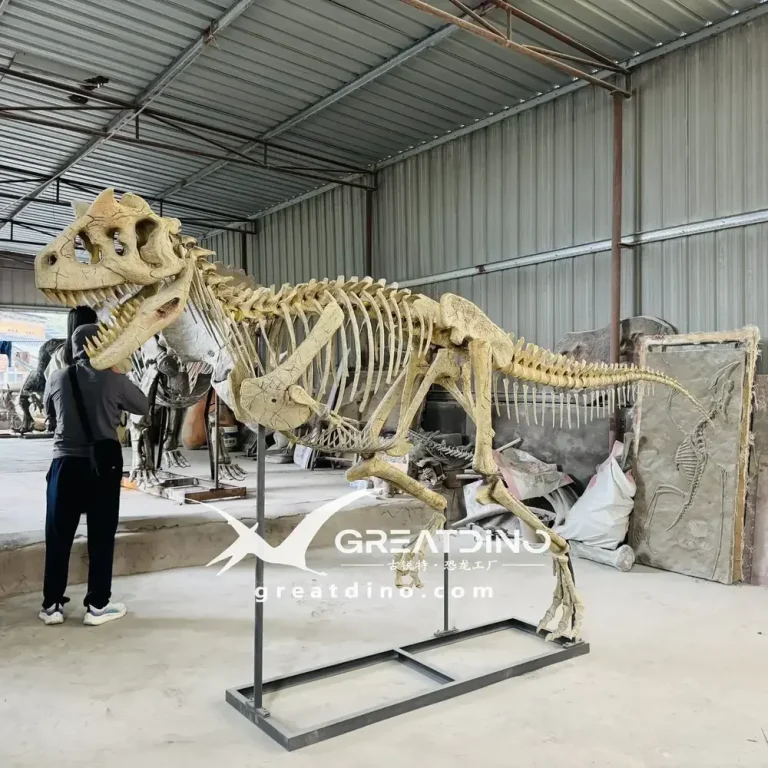 5M Fiberglass Dilophosaurus Skeleton Replica
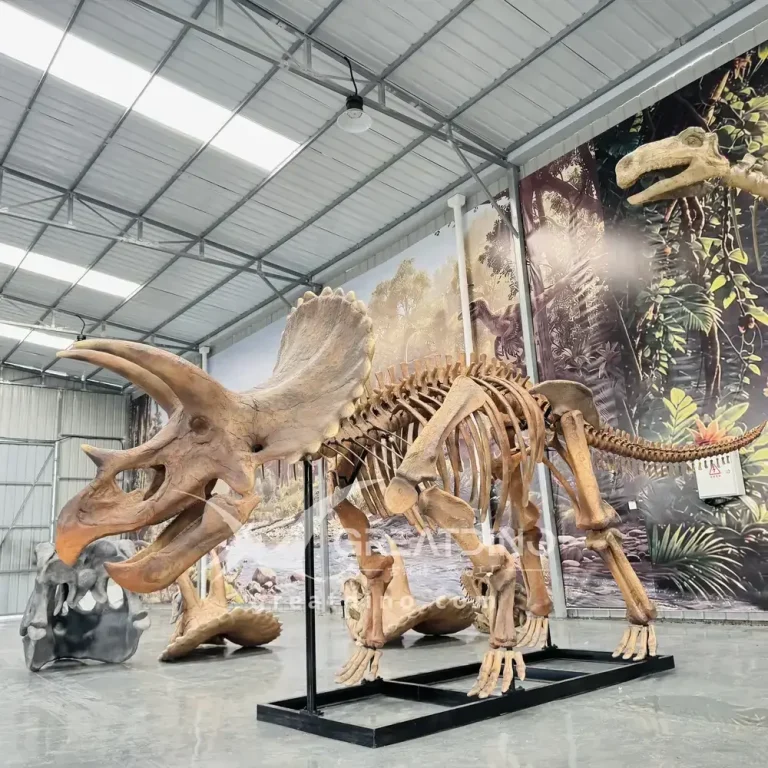 5M Triceratops Skeleton Replica for Museums
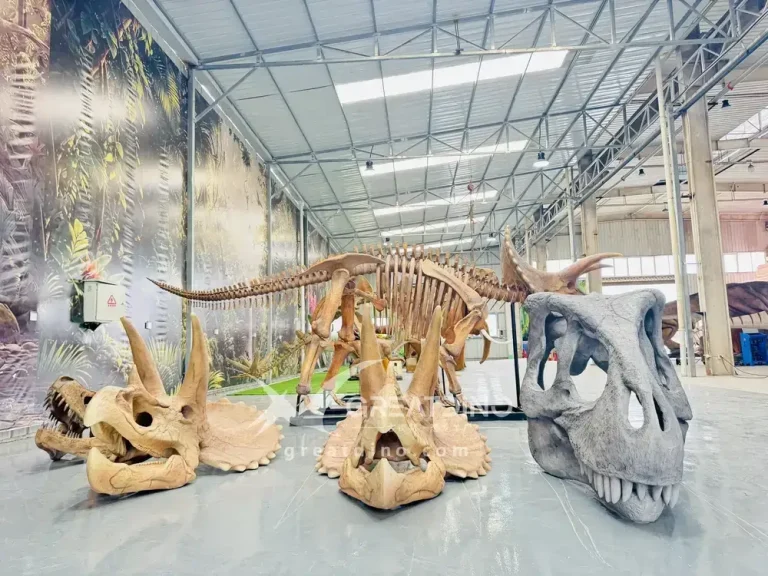 Custom Dinosaur Skull Fossil Replica for Museums
Related reading: buying guides for museums and theme parks and the full dinosaur skeletons & fossils range.
The things buyers usually want settled before they ask for a drawing.
A replica. The bones are cast in fiberglass with resin detail from reference material, mounted on a steel armature. No original fossil material is used, which means it can be handled, lit and installed without conservation restrictions.
Yes. The model breaks down at anatomical points with numbered bolted joints, and the skull and frill travel as one crated section. The reassembly drawing gives the sequence, which matters because the spine goes up before the rib cage.
The assembly is light for its size because the bones are hollow castings, but the armature and floor frame concentrate load at a few points. We issue a load drawing with point loads for your structural engineer before delivery.
It can, with the outdoor specification: UV-stable finish, sealed armature and stainless fixings. We recommend indoor display for a piece of this detail, because outdoor light and weather will degrade the surface faster than a painted animal model.
Nothing integral. The skeleton is lit by the venue's own spot lighting, and we supply a recommended lighting plan — usually a cool key from above and a warmer fill from the side, which is what brings out the bone texture.
40 to 55 days after drawing approval. Installation of the six-metre version is typically two to three days with two technicians and a small crane or gantry, followed by alignment and a final surface check.
The model ships in sections, with the head and jaw crated separately. Assembly is typically one day on site with a small crane, followed by a full movement test before handover.
Every project ships with a spare-parts list, a maintenance guide and the wiring diagram. Servo units and the jaw drive are individually replaceable on site, so a component can be swapped without returning the animal to the factory. A 2-year warranty and worldwide delivery and installation support are included.