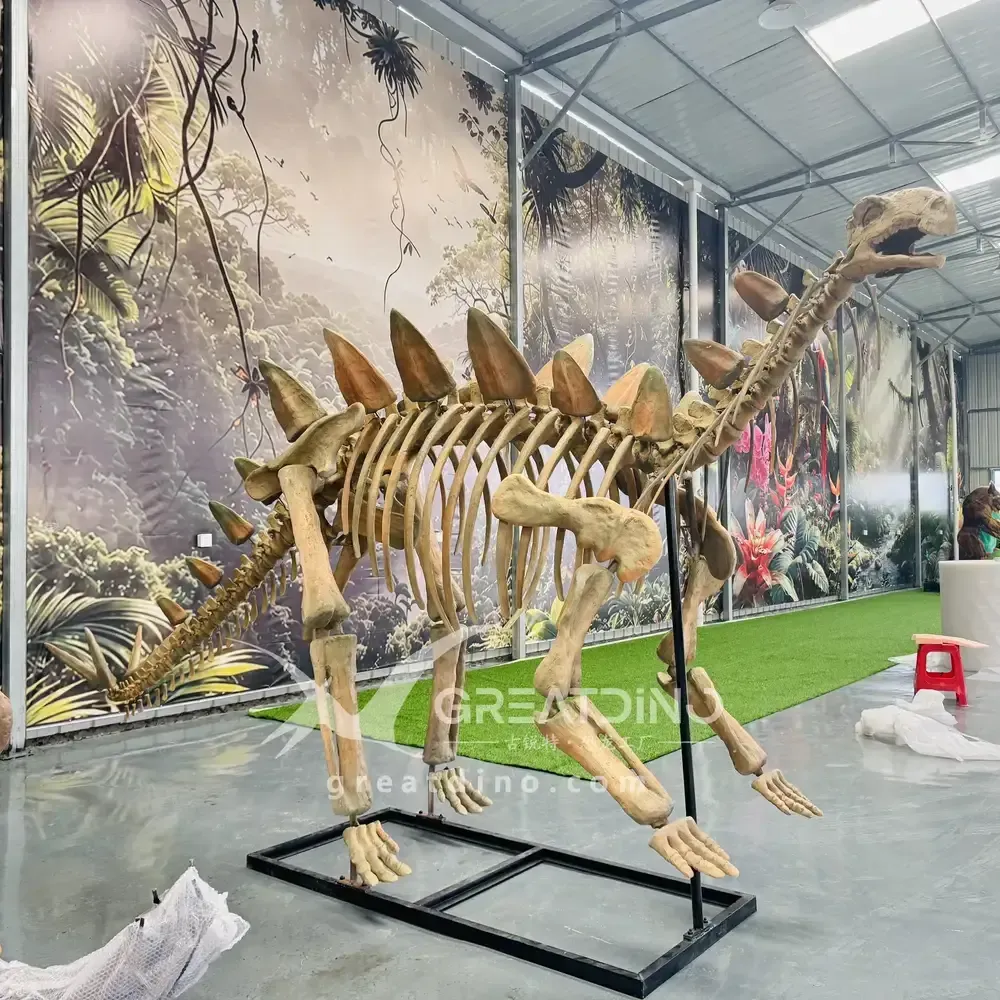
A four-metre Stegosaurus skeleton built around the two features that identify it — the paired back plates and the spiked tail — with the plate arrangement set as a skeletal structure rather than a row of flat cut-outs.
Every model is made to order. The figures below describe this build as specified; size, pose, colours and effects are configured around your site before the frame is laid out.
| 产品类型 / Product type | Full-size fiberglass dinosaur skeleton replica |
|---|---|
| Overall size | Length 4 m, height approx. 2.2 m at the tallest plate — custom sizing from 3 m to 9 m |
| Power | None required — static exhibit; optional spot lighting by others |
| Structure | Internal steel armature with bolted section joints · freestanding floor frame |
| Materials | Cast fiberglass bones with resin detail · steel armature · powder-coated support frame |
| Detail | Paired dorsal plates in alternating arrangement · four tail spikes · arched spine · small skull · limb articulation |
| Mounting | Freestanding on a floor frame; wall or ceiling suspension available on request |
| Weather rating | Indoor recommended; outdoor installation available with UV-stable finish and sealed armature |
| Lead time | 40–55 days after drawing approval |
| Warranty | 2 years on structure and finish, with worldwide delivery and installation support |
The back plates are the whole animal, and their arrangement is a genuine scientific argument that most replicas ignore.
The plates sat in two alternating rows along the spine, not a single line down the middle. They were not flat: each plate was a thin, curved structure with a raised centre and fluted surface, anchored to the spine at an angle. The largest sat over the hips and they diminished toward the neck and tail.
We build each plate as a separate curved casting with the fluting cut in, mounted on staggered brackets so the two rows interlock in the correct alternating pattern. A single row of flat plates — which is what most low-cost replicas do — turns a Stegosaurus into a generic spiky dinosaur and loses the one feature a visitor came to see.
The four tail spikes are the second identifier, and they change how the whole skeleton reads.
The spikes point out and slightly back, in two pairs, and they are set at the end of a tail that hangs clear of the floor. That clearance matters: a tail that rests on the ground makes the animal look like a static sculpture rather than a mounted skeleton, and it removes the shadow that the spikes cast, which is half the visual effect.
We build the tail as a series of cast vertebrae on a curved armature, with the spikes mounted on cast sockets at the correct angles. The tail is the most vulnerable section in transit, so it travels as its own crated piece with a rigid cradle.
A plate two metres across and a few centimetres thick is a thin-shell structure, and casting it without warping is the technical problem on this model.
We lay the plates up in matched moulds with a controlled thickness and a steel spine along the inner face, so the plate holds its curve and does not flex when the gallery’s air handling changes temperature. The bone surface carries the fluting and the growth lines, cast rather than engraved, so the detail survives the paint stage.
The skull is small relative to the body, which is correct for a Stegosaurus and often exaggerated on replicas to make the head more readable. We keep it at proportion because the small head is part of the animal’s identity.
This model is usually bought by a science centre or a museum education department, and that changes what it needs.
For teaching use, the value is in the parts that can be pointed at: the alternating plate rows, the four spikes, the arched spine, the small skull, the bird-like hips. We supply a labelled diagram and a short interpretation sheet with the model, so the education team does not have to build their own material.
Where the exhibit is interactive, the plates can be mounted on a low frame at child height instead of a full standing mount, so a school group can walk along the plate row and see the arrangement from above. That version is a different mount, not a different skeleton, and it is worth specifying at enquiry stage.
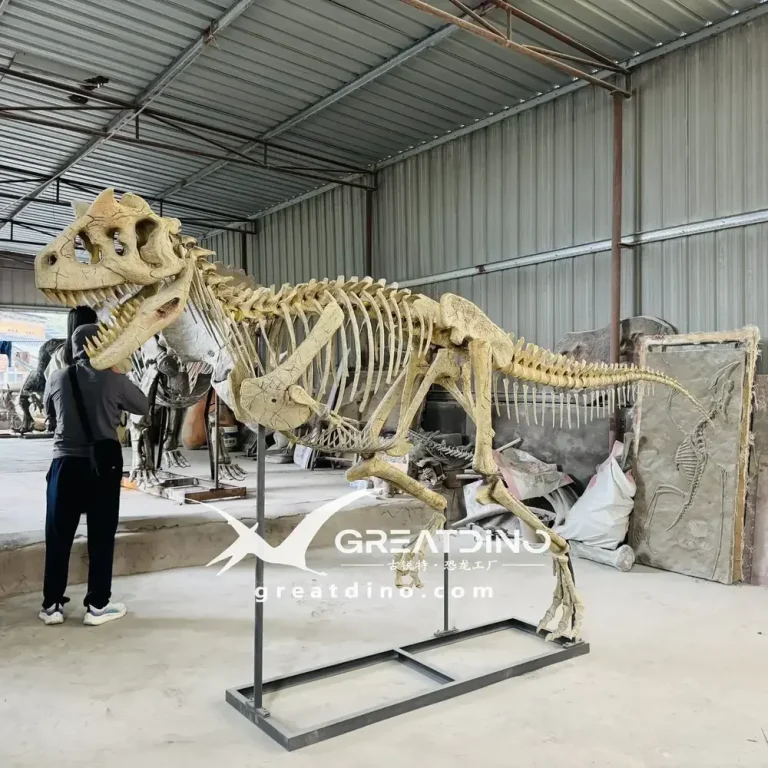 5M Fiberglass Dilophosaurus Skeleton Replica
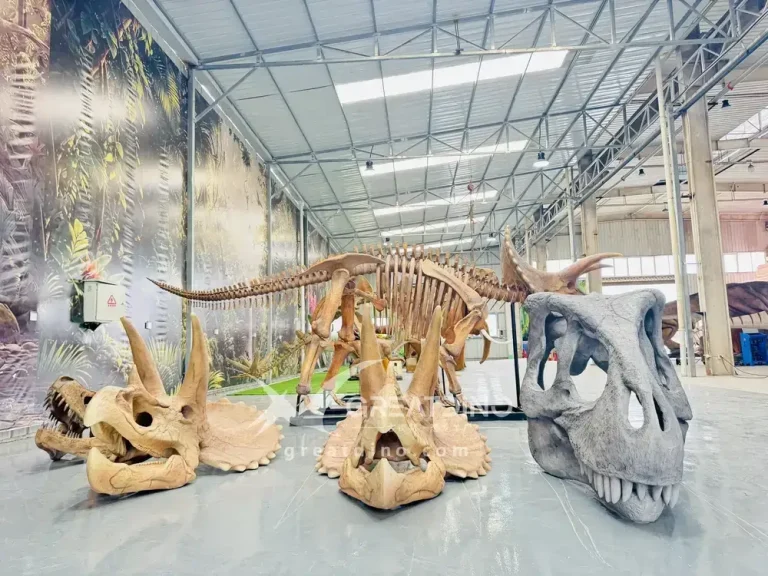 Custom Dinosaur Skull Fossil Replica for Museums
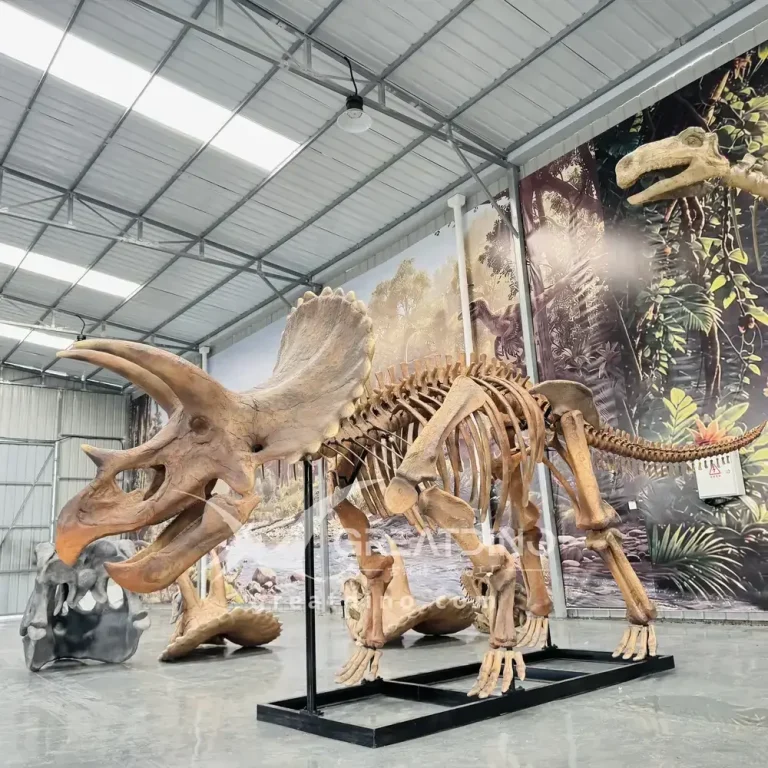 5M Triceratops Skeleton Replica for Museums
Related reading: buying guides for museums and theme parks and the full dinosaur skeletons & fossils range.
The things buyers usually want settled before they ask for a drawing.
Two alternating rows, which is the current interpretation of the skeleton. Each plate is a separate curved casting mounted on staggered brackets so the rows interlock. A single row of flat plates is cheaper but loses the defining feature of the animal.
Free-hanging, with clearance to the floor. The tail is a series of cast vertebrae on a curved armature, and the four spikes are mounted on cast sockets at the correct angles. A supported tail loses the shadow that makes the spikes read.
Yes, on a low frame rather than a full standing mount, so a group can look along the plate rows from above. That is a different mount rather than a different skeleton, and it is worth specifying when you enquire.
Yes. A labelled anatomical diagram and a short interpretation sheet ship with the model, covering the plate arrangement, the tail spikes and the skeletal features. Education teams often adapt it, but it saves them building material from scratch.
It can with the outdoor specification, but we recommend indoor display. Outdoor light and weather degrade the bone surface faster than a painted animal model, and a skeleton has more fine detail to lose.
Sections arrive crated on rigid frames with numbered joints and a reassembly drawing. The floor frame goes down first, then the spine, then the plates and the tail. Typically one to two days with two technicians and a small lift.
The model ships in sections, with the head and jaw crated separately. Assembly is typically one day on site with a small crane, followed by a full movement test before handover.
Every project ships with a spare-parts list, a maintenance guide and the wiring diagram. Servo units and the jaw drive are individually replaceable on site, so a component can be swapped without returning the animal to the factory. A 2-year warranty and worldwide delivery and installation support are included.