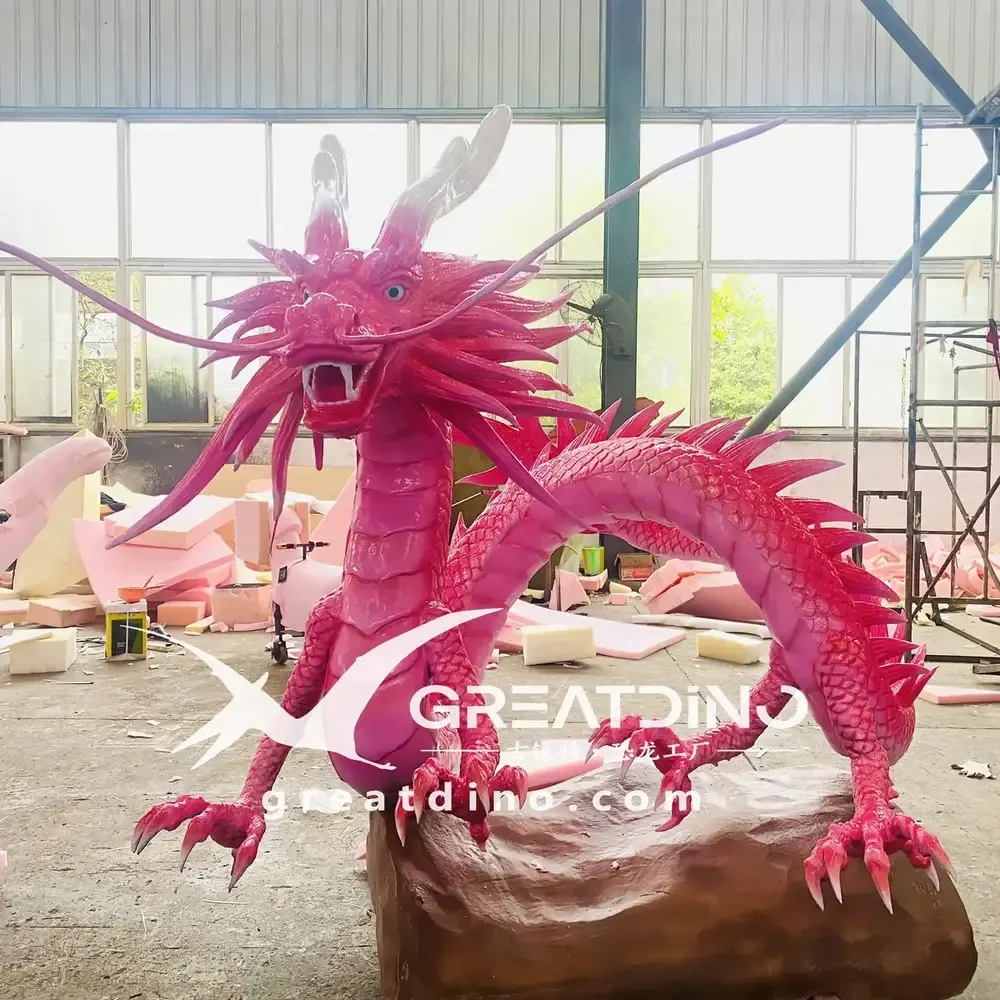
A Chinese dragon built as a coil rather than a straight line — four clawed limbs, a serpentine body that turns back on itself, and a head carrying the whiskers, horns and mane that make the form readable at a glance.
Every model is made to order. The figures below describe this build as specified; size, pose, colours and effects are configured around your site before the frame is laid out.
| Product type | Large electric animatronic mythical creature |
|---|---|
| Overall size | Body length 10 m along the coil, head height approx. 3.5 m — custom sizing from 6 m to 30 m |
| Power | 110 V / 220 V, specified per site; CE / UL certified components available |
| Power draw | Scales with movement count and body segments |
| Control | Industrial controller · remote · infrared sensor trigger · timed loop |
| Materials | Welded steel frame · high-density foam · 3–4 layer silicone hide with cast scale rows · fibre mesh reinforcement |
| Movements | Head turn, lift and lower · jaw open and close · body undulation along segments · forelimb gesture · tail sway |
| Effects | Optional mist · LED eyes · internal warm glow along the body · roaring or gong audio · sensor interaction |
| Weather rating | Outdoor rated, with sun and lightning protection; festival units built for repeated assembly |
| Lead time | 45–60 days after drawing approval |
| Warranty | 2 years, with worldwide delivery and on-site installation support |
A Chinese dragon is not a lizard with a long tail. It is a serpentine body arranged in space, and the arrangement is the design.
We build it in segments along a coil: the body rises from the base, turns back over itself, and the head comes forward at the top facing the approach. That coil is what gives the model its presence from every angle, and it is also what lets a ten-metre animal occupy a footprint of only about four metres. On a plaza or in a festival hall, that compact footprint is often the reason this model gets chosen over a straight-line creature.
Spacing between the coils is set at the drawing stage. Too tight and the body reads as a pile; too open and the animal loses the sense of length.
The head carries the cultural reading, and every element on it has to be right.
Horns sweep back from the crown, whiskers extend from the upper jaw, and a mane runs from the jaw line down the neck. We build the whiskers as flexible rods rather than rigid sculpture, so a visitor brushing past does not snap them. The jaw opens and closes on a drive, and the head turns and lifts — the lift is what lets the dragon look down at a crowd, which is the pose most festival photographs are taken from.
The four limbs each carry three or four claws depending on the reference. They are posed as gripping limbs, one raised, and the forelimb can gesture. What the limbs do not do is walk: a coiled dragon is a display animal, and building it to walk would triple the frame weight for a movement nobody books it for.
Chinese dragons are read through colour as much as form, and the palette is not a free choice.
The common builds are gold with red, jade green with gold, and red with gold trim. We cast the scale rows into the silicone so each one has an edge, then paint in layers: a base tone, a darker wash into the scale valleys, gold dry-brushed along the ridges, and a separate treatment for the mane and whiskers so they stay visually distinct from the body. On a gold build the metallic pigment is applied last so it does not get buried under the clear coats.
Interior lighting is worth specifying at the same time. A warm glow along the body behind translucent sections turns a daytime sculpture into a night-time centrepiece, and it is far cheaper to build into the frame than to add later.
The same design is built two ways, and the difference is in the joints.
Festival units are segmented with quick-release couplings, so the dragon can be broken down into transportable sections and reassembled on site by a small crew in a day. That version is specified for repeated assembly, with protected connector faces and a labelled sequence. It suits cultural festivals, touring shows and seasonal installations.
Permanent display units are welded and sealed at the joints, with the electrical runs enclosed inside the body. They are stronger, quieter and cheaper per metre, but they do not come apart. For a park or a museum forecourt that is the right choice; for an event that moves between cities, it is not.
Tell us which one you need at enquiry stage and we will quote the matching build. Retrofitting quick-release joints to a welded body is not practical.
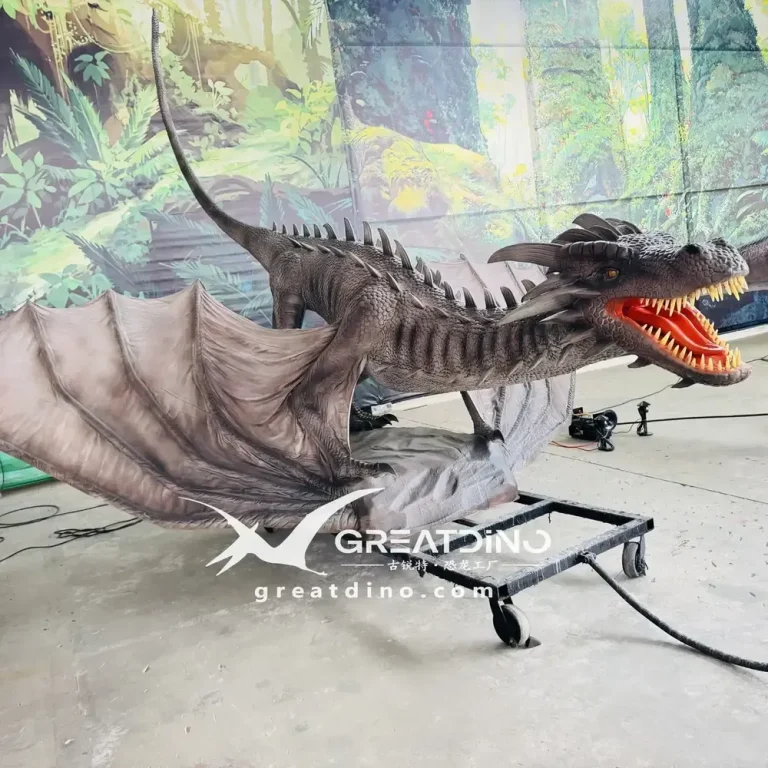 Mechanical Western Dragon Model
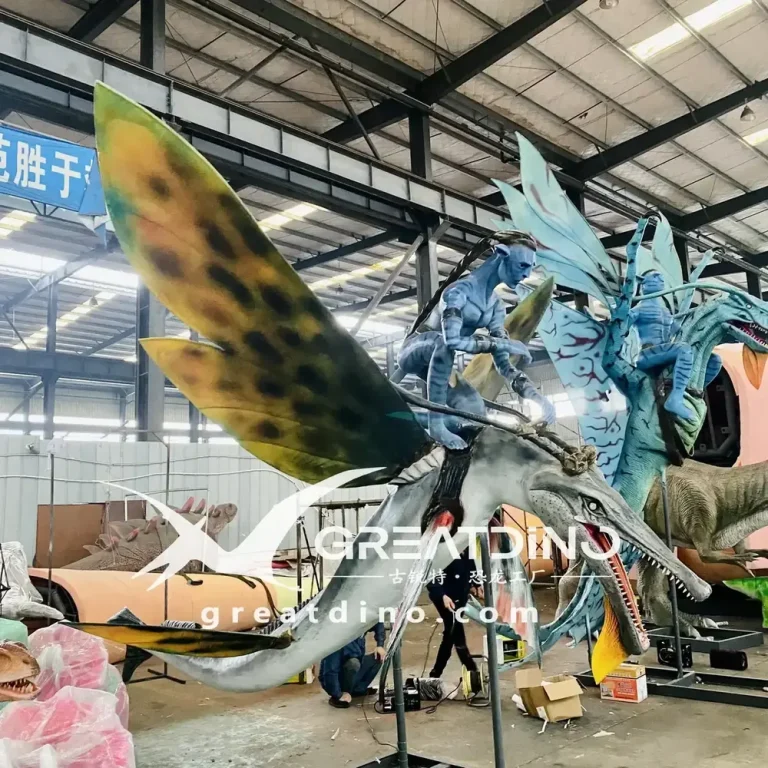 Life-Size Animatronic Avatar Ikran with Na’vi Rider
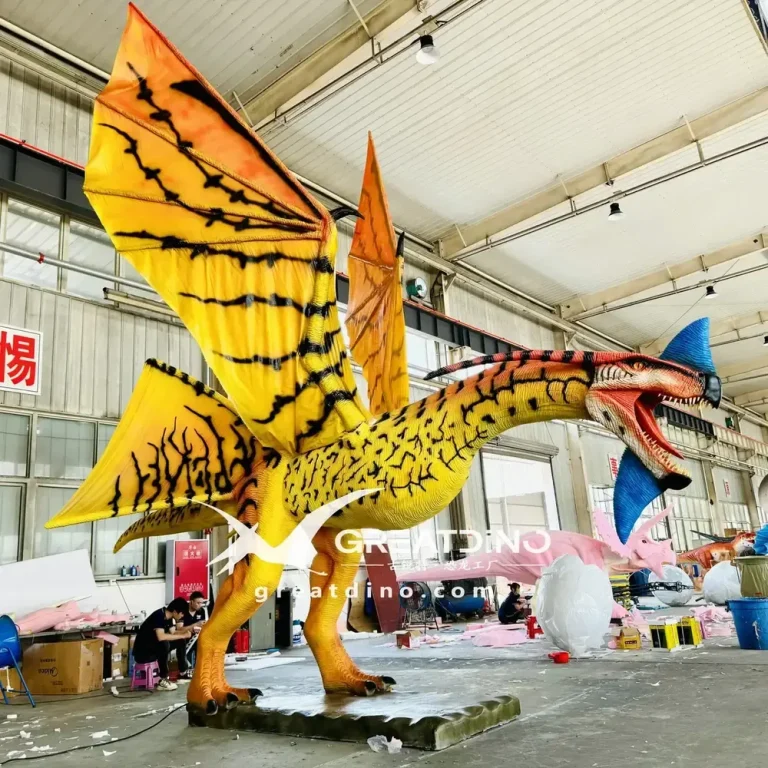 7M Animatronic Avatar Banshee Model with Wing Movement
Related reading: buying guides for museums and theme parks and the full animatronic dragons range.
The things buyers usually want settled before they ask for a drawing.
Yes, if you order the festival build. It is segmented with quick-release couplings and a labelled reassembly sequence, and a small crew can put it up in about a day. The permanent build is welded and does not come apart; the two are ordered as different products.
Gold with red, jade green with gold and red with gold trim are the standard builds, and custom matching to a cultural reference or a client's brand is normal. Colour and metallic finish are confirmed against a physical sample before production.
This model is ten metres along the coil. The same design scales from six metres for an indoor hall up to thirty metres for a segmented festival dragon, which we build as a separate specification with more drive segments.
The head turns, lifts and lowers on its own drive, and the jaw opens and closes separately. Body undulation runs along the segments on a linked cycle. The four limbs are posed, with one forelimb able to gesture.
Yes. Indoor units are built lighter, with a reduced coil height to suit ceiling clearance and a fixed head-lift range. We ask for the ceiling height and the rigging points before drawing, because an indoor coil is often suspended rather than floor-mounted.
Annual inspection of the drive couplings and electrical connectors, cleaning of the scale surface, and touch-up of the metallic finish where visitors can reach it. Festival units get a connector inspection before each assembly. A maintenance guide and spare-parts list ship with the model.
The model ships in sections, with the head and jaw crated separately. Assembly is typically one day on site with a small crane, followed by a full movement test before handover.
Every project ships with a spare-parts list, a maintenance guide and the wiring diagram. Servo units and the jaw drive are individually replaceable on site, so a component can be swapped without returning the animal to the factory. A 2-year warranty and worldwide delivery and installation support are included.