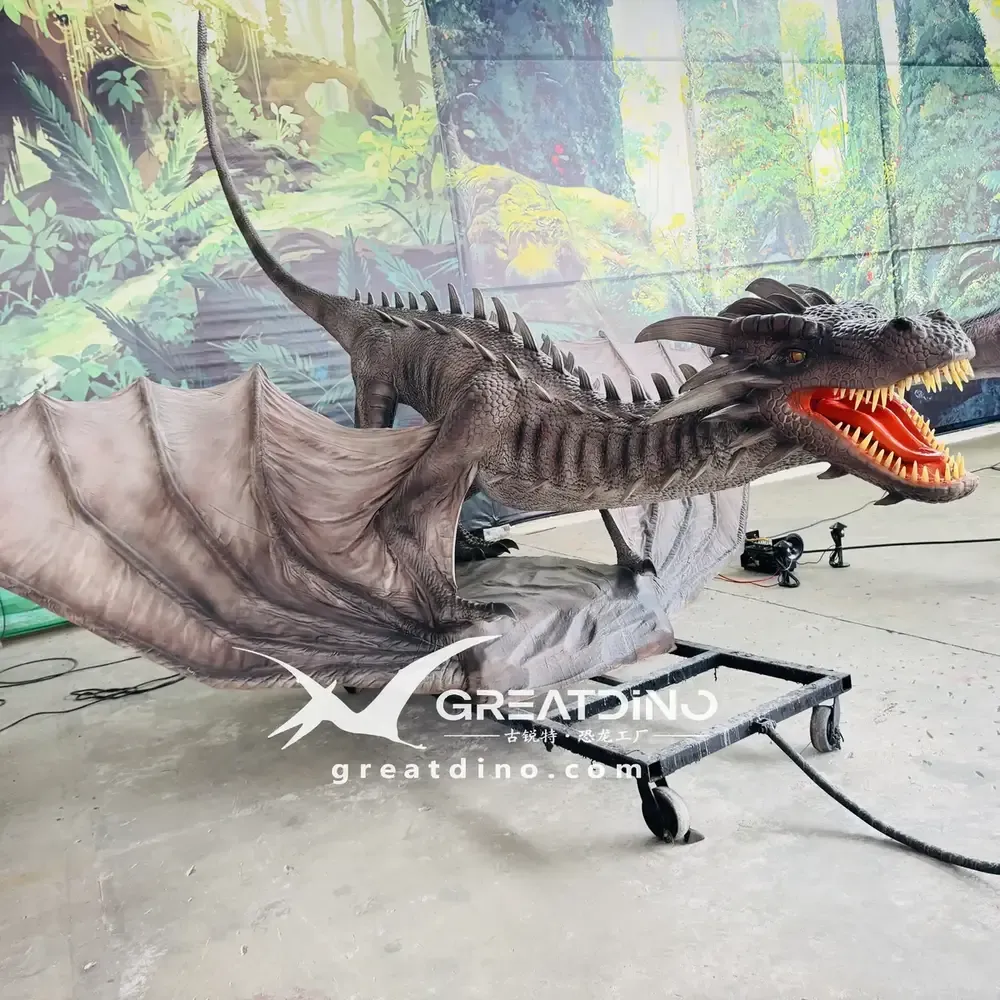
A western dragon built on the same steel-and-silicone logic as our dinosaurs, with one addition that changes everything: a membrane wing that opens. Scaled hide, spined spine, a jaw that works and a head that turns to follow visitors.
Every model is made to order. The figures below describe this build as specified; size, pose, colours and effects are configured around your site before the frame is laid out.
| Product type | Large electric animatronic fantasy creature |
|---|---|
| Overall size | Body length 6 m, wingspan 8 m open, standing height approx. 2.8 m — custom sizing available |
| Power | 110 V / 220 V, specified per site; CE / UL certified components available |
| Power draw | Higher than a dinosaur of the same size when wing movement is included |
| Control | Industrial controller · remote · infrared sensor trigger · timed loop |
| Materials | Welded steel frame · high-density foam · 3–4 layer silicone hide with cast scale detail · fibreglass wing spars · coated membrane wing skin |
| Movements | Wing open and fold · neck turn and lower · jaw open and close · tail sway · body rock · optional head lift |
| Effects | Optional smoke or mist breath · LED eyes · glowing throat · roaring audio · sensor interaction |
| Weather rating | Outdoor rated, with sun and lightning protection; membrane wings specify a wind-load limit |
| Lead time | 40–55 days after drawing approval |
| Warranty | 2 years, with worldwide delivery and on-site installation support |
Nobody walks past a dragon and asks what material the scales are. They see the outline first: the sweep of the neck, the spread of the wing, the spikes down the spine.
That is why the drawing stage matters more on a dragon than on a dinosaur. We start from the silhouette the site will actually see — from the path, from the car park, from the entrance gate — and build the pose around that sightline. A dragon designed to look good in a three-quarter product photograph often reads as a lump from the angle visitors approach it.
The default stance is low and forward, wings half-raised, head at visitor height. It is the pose that reads as a threat without requiring the model to be enormous, which keeps the frame, the foundation and the freight cost inside reason.
The wing is the feature buyers ask about, and also the one that has to be specified honestly.
Our wing is a fibreglass spar structure with a coated membrane skin, driven to open, hold and fold. The open span on this model is eight metres; that span is a sail, so the mechanism is rated for a wind load and the installation instructions specify an anchor pattern. On an exposed site we recommend the wing parked closed when the venue is not operating.
What the wing does not do is flap fast enough to suggest flight. A wing that beats looks mechanical at any size, and the load on the spar and the frame rises sharply. The movement we build is a slow open with a slight settle at the top, which reads as a creature spreading its wings to threaten — closer to how the animal would actually behave, and far more durable.
The hide is where a dragon either looks like a creature or like a fairground prop.
We cast individual scale rows into the silicone rather than printing a pattern, so the surface catches light and shadow at different angles along the neck, the flank and the tail. The spine carries a line of cast spikes in graduated sizes, and the head is built with brow ridges, cheek spikes and a jaw line deep enough to hold a real bite profile.
Paint is layered: a dark base, a mid-tone wash into the scale valleys, then dry-brushed highlights along the ridge of each scale row, with a warmer tone under the jaw and belly. Buyers usually choose between a stone-grey build, a dark green build and a black-and-ember build; custom colour matching to a brand or an art reference is standard.
The same model is installed two ways, and the choice changes the frame.
Ground-mounted is the default: the dragon stands on a steel base plate on a concrete pad, with the wing structure self-supporting. It suits a trail, a plaza or a park entrance, and it is the version that can be relocated later with a crane.
Suspended installation is used indoors where floor space is scarce — a museum atrium, a mall ceiling, a covered walkway. For that version the frame is built with certified lifting points and the wing is fixed in an open pose rather than driven, which removes the wind load problem and reduces weight. Tell us at enquiry stage which one you need; the two frames are not interchangeable.
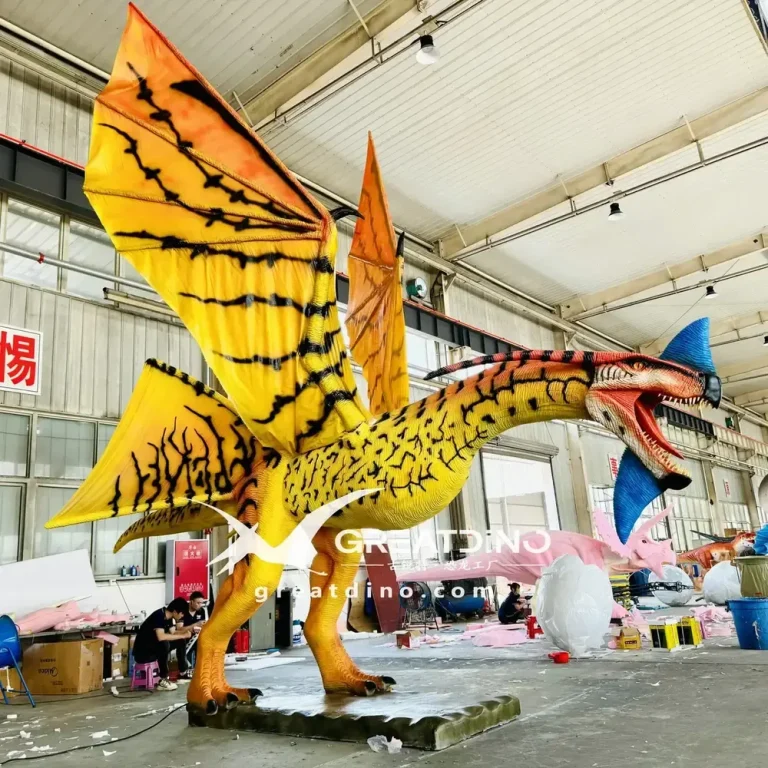 7M Animatronic Avatar Banshee Model with Wing Movement
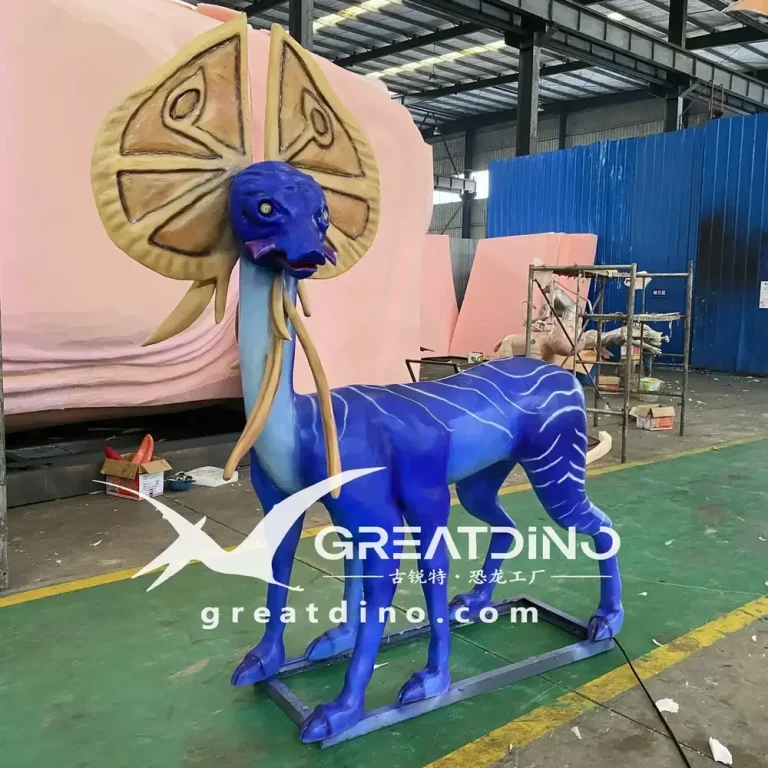 2M Animatronic Avatar Hexapede Creature Model
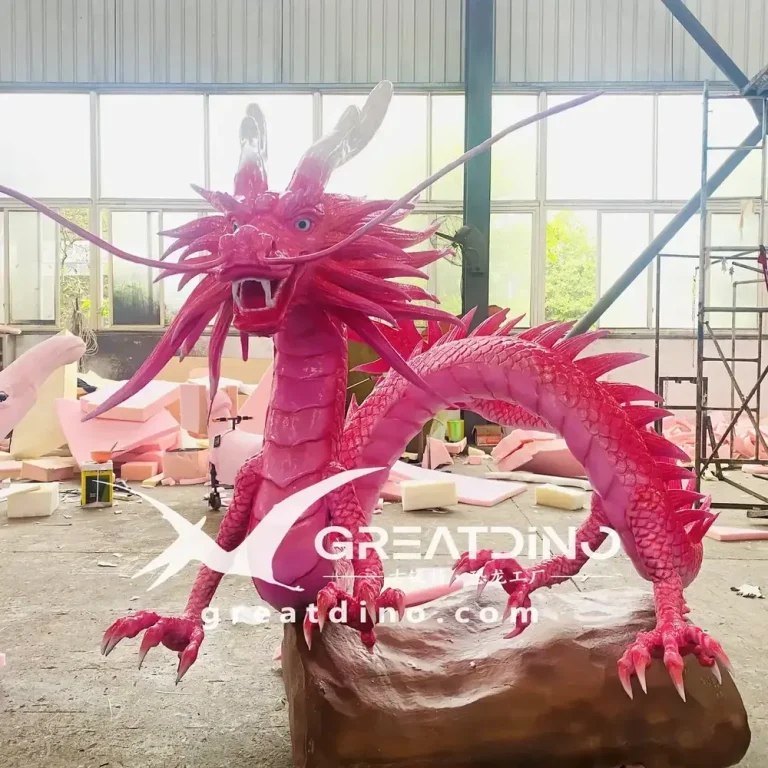 Large Animatronic Chinese Dragon
Related reading: buying guides for museums and theme parks and the full animatronic dragons range.
The things buyers usually want settled before they ask for a drawing.
The wing opens, holds and folds on a slow drive. It does not beat fast enough to suggest flight — that movement looks mechanical at this scale and puts heavy load on the spar. The slow open with a settle at the top reads better and lasts longer.
The wing is a sail, so we rate the mechanism and specify an anchor pattern for your site's wind zone. On exposed sites we recommend parking the wing closed outside operating hours. A suspended indoor version has no wind load.
Yes. Standard builds are stone grey, dark green and black-and-ember, and custom matching to a brand colour or an art reference is normal for us. Colour is confirmed against a physical sample before production.
Yes, and they are different builds. The western dragon is a four-limbed creature with membrane wings; the Chinese dragon is a long segmented body with four clawed limbs and no wings, usually installed as a coil. See the Chinese dragon model for that version.
Smoke or mist breath, LED eyes, a glowing throat, roaring audio and motion-triggered movement. On a dragon the breath effect earns its place more than on a dinosaur because visitors expect fire; we use a water-based mist with warm lighting rather than anything combustible.
Ground version: concrete pad to our drawing, one to two days with a crane, then wing and movement testing. Suspended version: certified lifting points in the structure above, installed by your rigging contractor to our load drawing, with our technician on site for commissioning.
The model ships in sections, with the head and jaw crated separately. Assembly is typically one day on site with a small crane, followed by a full movement test before handover.
Every project ships with a spare-parts list, a maintenance guide and the wiring diagram. Servo units and the jaw drive are individually replaceable on site, so a component can be swapped without returning the animal to the factory. A 2-year warranty and worldwide delivery and installation support are included.