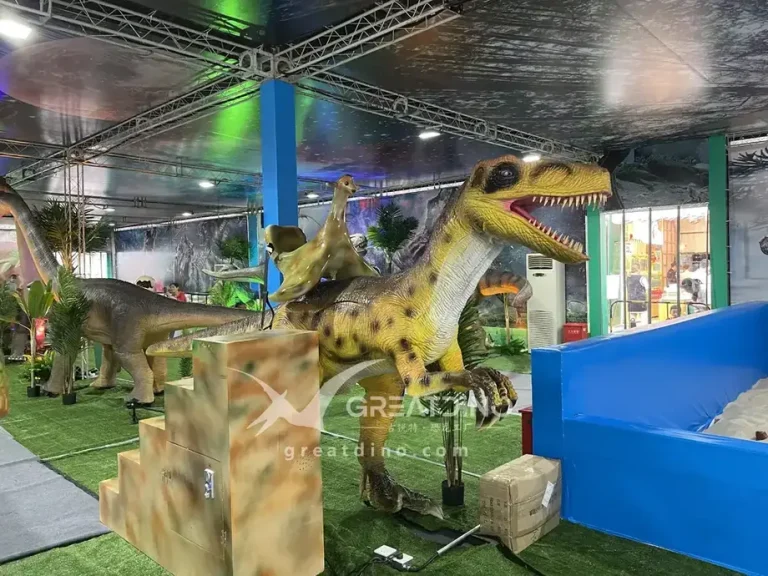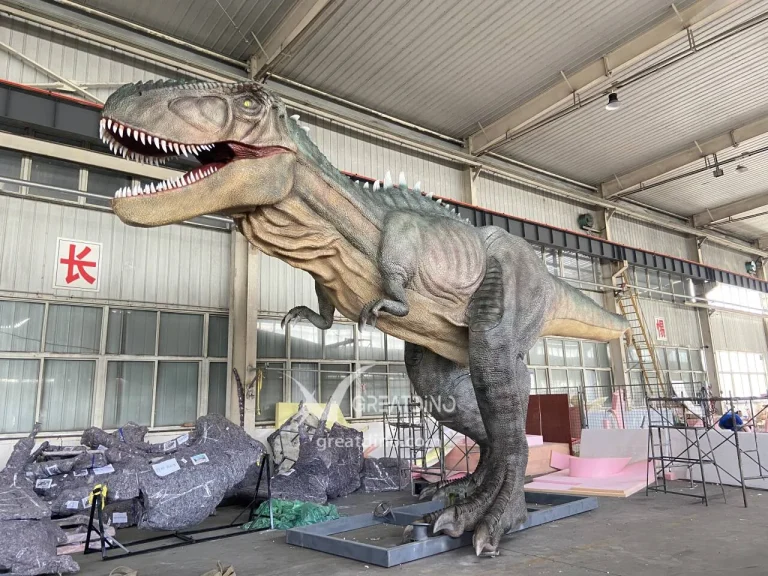
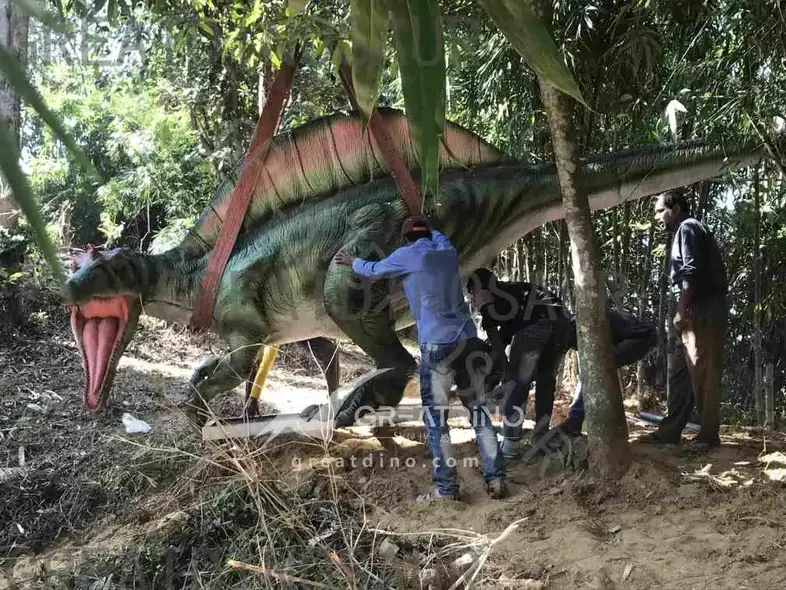
Roughly seven in ten of the animatronic dinosaurs we ship go outdoors, and the majority of the problems reported in the first year are site problems rather than model problems: a base that was never poured, a circuit shared with a pump, water standing in the base after the first storm. None of it is exotic. All of it is cheaper to fix before the container is booked.
This is the site-preparation guide we send with every outdoor quotation — foundations, power, drainage, wind and access — written so it can be handed to a contractor who has never installed a dinosaur.
The five things that must exist before delivery
| Item | What “done” looks like | Who owns it |
|---|---|---|
| Foundation | Concrete pad or footing, cured 7 days minimum, anchor bolts set to the drawing | Your contractor |
| Power | Dedicated circuit, breaker labelled, earth leakage protection, socket within reach of the cabinet | Your electrician |
| Drainage | Base area falls away from the model; the model’s own drain runs freely | Your contractor |
| Access | Vehicle route to within 10 m of the position, ground bearing for a loaded truck | You |
| Clearance | 800 mm of service space on the maintenance side, 2 m clear of the moving arc | You |
The order matters. Power and foundation are the two items that cause the longest delays, because both need someone else’s calendar. Start them when the order is placed, not when the ship departs.
Foundations: the load is not what you think
A 6 m animatronic dinosaur weighs far less than the concrete it stands on. The design driver is not dead weight but moving load and wind:
- Point loads at the anchors. A moving neck creates reaction force at the base, not just weight. Four anchor points, each taking a share that is larger than one quarter of the total, is the normal assumption.
- Overturning from wind. A tall model is a sail. A 10–12 m animal presents tens of square metres of surface, and the footing has to resist the moment from the local design wind speed.
- Frost and clay. Sites with freeze-thaw or expansive clay need depth below the active layer, or the pad will lift and the anchors will loosen within two winters.
- Vibration. A model on a suspended slab — rooftop, deck, upper floor — transmits movement into the structure. That is an engineer’s question, not a supplier’s, and it needs answering before the order.
The drawing we supply gives point loads in kN, anchor positions, bolt specification and a minimum concrete volume. Hand it to a structural engineer for anything above 8 m, on a suspended slab, or in high-wind zones.

Power: size it from the axes, not the length
Power follows the number of actuators and the drive type. A four-axis DC model can draw less than a 3 m unit with eight servo axes. What to ask the supplier for, and give your electrician:
| Number | Why it matters |
|---|---|
| Connected load (kW) | Sizes the cable and the breaker |
| Starting current | Compressors and large motors draw a surge; a breaker sized on running load trips on start |
| Voltage and phase | Single or three phase changes the site works entirely |
| Earthing requirement | Metal frame outdoors needs a defined earth, especially where lightning is common |
| Cabinet position | Decides where the cable terminates and what the maintenance access looks like |
Three site habits prevent most electrical call-outs:
- Dedicated circuit per model. Sharing with a pump, a fountain or pathway lighting means the model resets whenever the other load trips.
- Earth leakage protection on the circuit, and a separate isolator within sight of the model so staff can cut power without walking to a plant room.
- Voltage stability. Servo drives fault on dips. Sites on generators, or at the end of a long rural line, should specify a stabiliser as part of the package rather than discovering the need in the first week.
Weather protection: what three to four layers actually do
Outdoor skin is built as layers, and the layer count is the specification that matters most:
- Three to four coats of silicone over the foam and frame, with UV-stable pigment. This is what resists rain and sun, and it is the first thing to verify in a quotation.
- Sealed joints at every moving axis. Water enters at joints, not through the skin surface.
- Drained base. A 30 mm drain plus 100 mm clearance under the frame stops the most common corrosion complaint we see.
- Stainless fasteners on coastal sites — throughout, not only where visible. Salt reaches the hardware before it reaches the motor.
- Lightning and surge protection where storms are frequent; the control cabinet is the expensive part and the easiest to protect.
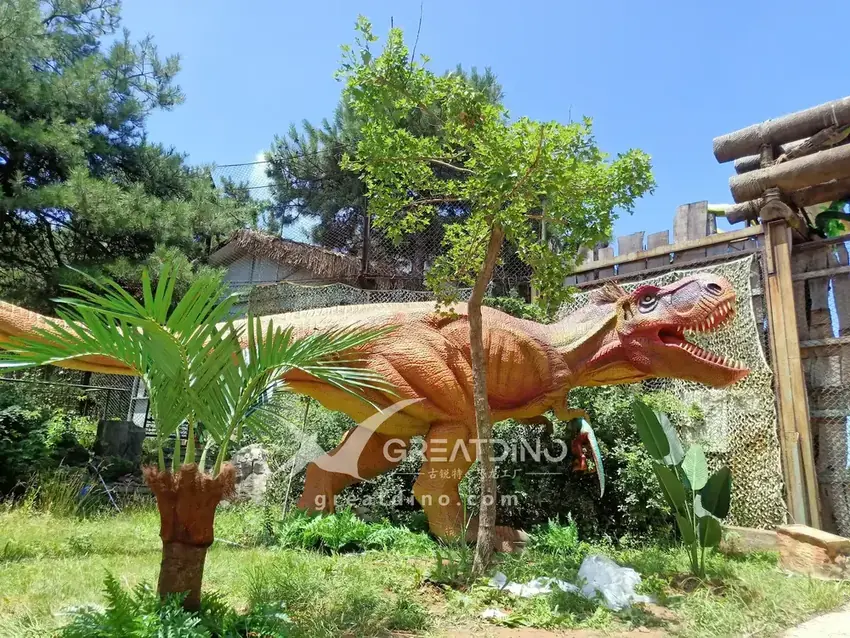
Wind: the specification question buyers forget
Ask two questions at quotation stage and the answer will shape the base design:
What is the design wind speed for the site? Coastal and exposed sites run far higher than inland sheltered ones. Does the model need to survive a storm, or be demounted for one? Some parks prefer removable sections with a quick-release joint; others want a fixed installation engineered for the worst case.
Practical measures that cost little:
- Orient tall models so the broadest surface faces the prevailing wind’s edge, not its face.
- Keep a 2 m clear zone upwind; a shed or fence close to a model creates turbulence that loads the frame unevenly.
- Above 12 m, expect a structural calculation and a signed installation note.
Access and unloading: the 200 m problem
The last 200 m decides more installations than the design does. Check before shipping:
| Constraint | Check | If it fails |
|---|---|---|
| Gate width | Wider than the widest crate plus 300 mm | Partial unpacking on the road; book a crane |
| Ground bearing | Loaded truck will not sink; gravel and wet lawn both fail | Hard standing or steel plates |
| Overhead | Branches, cables, archways clear of the tallest crate | Section the model or re-route |
| Turning circle | A 40 ft container needs roughly 30 m of straight approach | Smaller vehicle, more trips |
| Distance to position | Under 10 m for forklift reach | Handling plan, or crane |
Commissioning day: a checklist that fits on one page
- Foundation cured, anchors torqued to the stated value, base level within 5 mm.
- Power isolated, then connected by an electrician; earth continuity confirmed.
- Frame sections assembled in the numbered sequence; skin panels fitted last, joints sealed.
- Each axis run individually, then the full program, with no obstruction in the arc.
- Operator briefing: start, stop, emergency stop, program selection, what to log.
- Photo and video of the finished install, with the serial number, for your records.
- Site cleared of packaging; the documentation pack and spares handed over, not left in the crate.
Frequently asked questions
Can animatronic dinosaurs stay outside all year?
Yes — around 70% of our clients install outdoors, and the skin is built with three to four silicone layers against rain and sun. What shortens life outdoors is standing water at the base and unsealed joints, both of which are site issues rather than product limits.
Do they need a shelter?
Not usually. A shelter helps in extreme UV or where hail is common, and it changes the maintenance interval rather than the feasibility. What matters more is drainage and airflow around the base.
What about lightning?
Where storms are frequent, fit surge protection at the cabinet and confirm the frame is earthed. The mechanics survive lightning damage far better than the electronics do, so the cabinet is where the money should go.
How much concrete does a base need?
It depends on height, wind load and soil. A 3–5 m model commonly sits on a pad of a few square metres with cast-in anchors; a 12 m model needs a designed footing. We supply the point loads and a minimum volume; an engineer signs off anything tall or on poor ground.
Can we move a model later?
Yes if it was built in sections and the anchors are accessible. Cutting a base out of a poured footing is possible but destructive; if relocation is likely, say so at order and specify a bolted base plate on a separable plinth.
Send the site plan, the power available and the design wind speed if you have it, and we will return the footing requirement and the base drawing with the quotation rather than after it. Send your site details, or read the FAQ for outdoor use and warranty terms.