Buyers rarely see the inside of the workshop that builds their dinosaur, and the gap is where most misunderstandings live: why a quotation takes a week, why a change after painting costs so much, why two models that look identical are priced 40% apart. The build has eight stages, and each one has a visible output you can ask to see.
This is what happens in a Zigong workshop between the drawing and the container, with the checks that matter at each stage and the documents you should receive.
The eight stages
| Stage | What happens | What you can ask to see |
|---|---|---|
| 1. Reference and drawing | Species proportions fixed from skeletal references; pose and size agreed | Dimensioned elevation with the pose drawn |
| 2. Steel frame | Welded frame sized for the loads; drive mounts positioned | Photos of the bare frame, weld quality, mount positions |
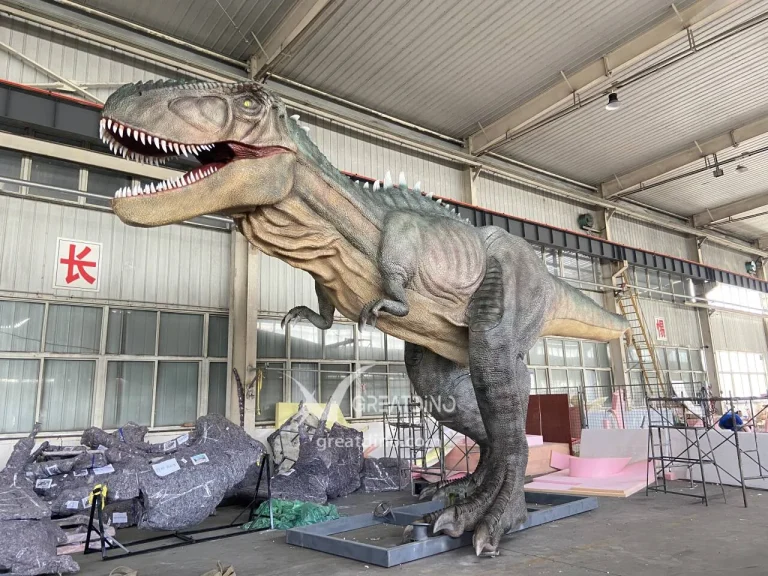
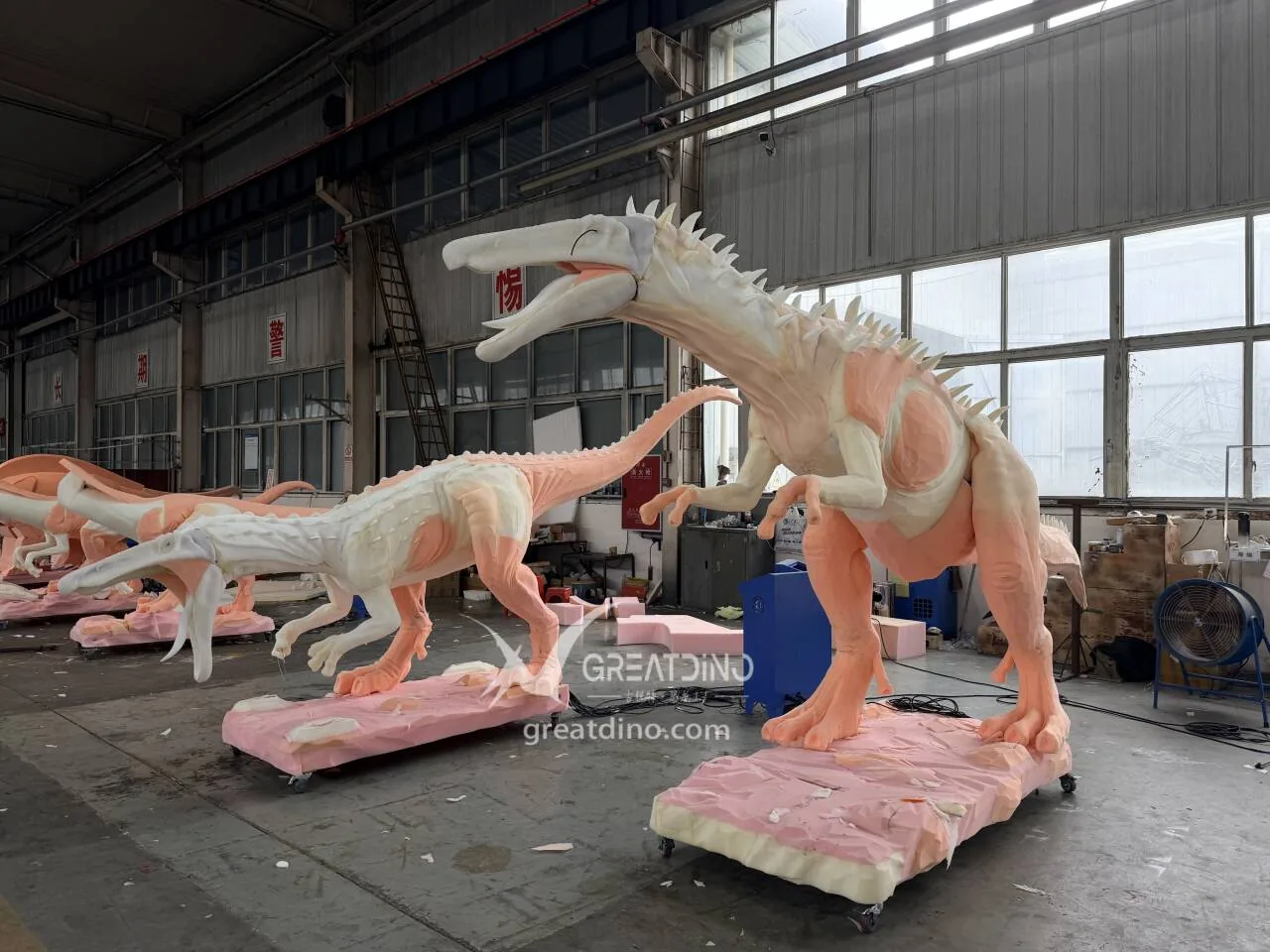
| 3. Shape modelling | Foam and clay build the volume over the frame | Four-angle photos of the sculpt with a scale reference |
| 4. Moulding (for repeated or fibreglass parts) | Glass fibre or silicone mould taken from the sculpt | Photos of the mould and the first pull |
| 5. Skin | Three to four silicone layers over foam and frame; texture pressed in | Skin in progress, seam positions at joints |
| 6. Painting | Base coat, pattern layers, detail; eyes and mouth finished | Daylight photos beside the approved colour reference |
| 7. Mechanism and control | Actuators mounted, wired, programmed; cabinet built and labelled | Wiring diagram, cabinet photo, parameter backup |
| 8. Test and packing | Full cycle per axis, timed programs, then export packing | Motion test video with the serial number in frame |
1. Reference before sculpt
A convincing animal is a set of correct proportions, and proportions come from a source, not from memory. For dinosaurs that means published skeletal reconstructions; for living animals it means photographic reference of the real species at several ages.
What this changes for a buyer: if you need a specific look — a particular museum mount, a film character, a regional subspecies — say so at this stage. Changing the reference after the sculpt exists means resculpting, and resculpting is the most expensive kind of change in the whole process.
2. The frame is where the price hides
Two models can share a skin and differ by 40% in price, and the difference is usually invisible: wall thickness, section size, the number of drive mounts, whether the base is designed for a crane lift.
| Frame question | Cheap answer | Durable answer |
|---|---|---|
| Section | Thin wall tube, welded where convenient | Section sized to the load, gusseted at joints |
| Drive mounts | Brackets added after the frame is built | Mounts designed in, so the axis sits on the frame’s strong line |
| Base | Flat plate, four holes | Plate with lifting points and levelling allowance |
| Corrosion | Paint over mill scale | Shot blast, primer, then topcoat |
Ask for frame photos before skin. Once the animal is skinned, the frame is a rumour.
3 and 4. Sculpt, then mould
The sculpt fixes volume, pose and the read of the species. The mould is a production decision: a fibreglass model or a repeated part justifies a mould; a one-off animatronic skin usually does not, which is why the two product types have different cost curves.
This is also where the two product families split:
- Fibreglass statues are pulled from a mould, which makes the second and third copy cheaper than the first. Repeat orders and matched sets become economical.
- Animatronic models are skinned directly over the frame because every joint has to flex. No mould, and no saving on the second unit unless the sculpt is reused.
5. Skin: three to four layers, and why the count matters
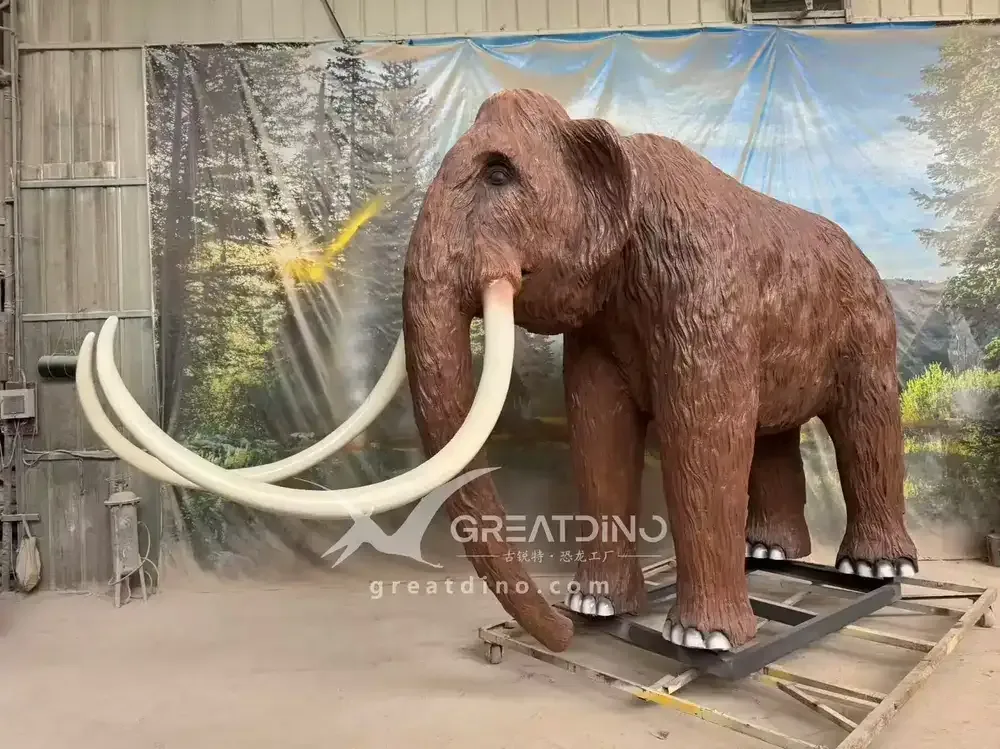
Skin is where outdoor life is decided. The build is layered: a base coat bonded to the foam, then successive silicone coats, with texture pressed in while the surface is still workable. For outdoor models the specification is three to four layers with UV-stable pigment.
Practical consequences:
- Layer count is the weather specification. A two-layer skin looks the same on day one and fails first in year two.
- Seams belong at joints, and joints are where water gets in. Seam quality at shoulder, hip and jaw is the single best thing to inspect in pre-shipment photos.
- Silicone can be repaired. A patch with the same silicone and pigment is invisible from a metre away; a split left alone reaches the backing and needs a panel.
6. Painting: daylight, not screens
Paint is applied in layers — base, pattern, detail, then a clear protection where specified. Colour approval on a monitor is unreliable; the same file looks different on every screen. Ask for daylight photographs beside the reference swatch, and if the animal is a known species, ask for the pattern to be checked against photographs rather than a memory of the animal.
Fade is normal outdoors. What accelerates it is a thin clear coat and a dark base colour in high-UV climates; what slows it is a repaint of the exposed upper surfaces every three to five years, which costs far less than a full repaint.
7. Mechanism: the part visitors never see, and buyers underestimate
The mechanism is mounted on the frame’s strong lines, wired to a labelled cabinet and programmed. Three things are worth insisting on:
- A labelled cabinet. Each cable marked with the axis it feeds. Unlabelled cabinets turn every later fault into a process of elimination.
- A parameter backup on removable media. Servo systems are reliable until a drive is replaced; without parameters the replacement must be re-tuned on site.
- A control method matched to the venue. Coin or attendant control for rides, remote and timer for park models, motion sensor for interactive exhibits. The same mechanics, three different cabinets.
8. Test, then pack
Every joint is cycled before packing. Ask for video per axis with the serial number visible: it is both a quality record and your baseline for diagnosing noise in year three.
Packing is a design decision, not a wrapping one:
| Item | Export-grade practice |
|---|---|
| Crate | Plywood or steel-framed, plywood-lined, fumigation-compliant timber where required |
| Blocking | Foam blocking at the base and at every protrusion; nothing load-bearing on the skin |
| Moisture | Desiccant bags and a vapour barrier for sea freight |
| Strapping | Steel strapping to the crate floor, not to the skin |
| Documents | Packing list inside, and a copy emailed before departure |

What this means when you compare suppliers
Four questions, asked with the photos above in mind, separate a build from a promise:
- “Can I see the frame of my model before skin?” A supplier who cannot photograph a frame is buying frames in.
- “How many silicone layers, and is the pigment UV-stable?” Vague answers here predict a short outdoor life.
- “Will the cabinet be labelled, and do I get the parameters?” This is the difference between a two-day and a two-week repair.
- “Can I watch a live motion test?” A recorded clip can be from any unit; a call cannot.
Frequently asked questions
How long does building one model take?
There is no fixed figure — it depends on size, axis count and the workshop schedule, and peak season is longer. What is predictable is the sequence: the sculpt and skin stages take the longest single blocks, and the test and packing stage is short but cannot start until everything else is finished.
Are the models made by hand?
Largely. The frame is welded, the mechanism is assembled from industrial components, but the sculpt, skin texturing, seams and paint are hand work. That is why two units of the same model differ slightly, and why the sculpt approval stage matters.
What materials go into one?
A steel frame for structure, high-density foam for volume, silicone for the skin in three to four layers outdoors, and oil paint for colouring. Fibreglass replaces foam and silicone on static statues.
Can I visit the workshop?
Yes, and buyers who do tend to change one thing in their specification afterwards. Visits are arranged around production so there is something to see rather than an empty floor.
Do you build from a customer’s own drawing?
Yes, including film characters and fantasy creatures, provided the drawing or reference is detailed enough to build from. Where a reference is only a single image, we produce our own drawing package first and you approve that.
If you want to see these stages on a live order, ask for frame photos and a motion test call as part of the offer — both are normal requests, and both tell you more than a catalogue page. Ask for a production schedule, or see the product ranges for finished examples.