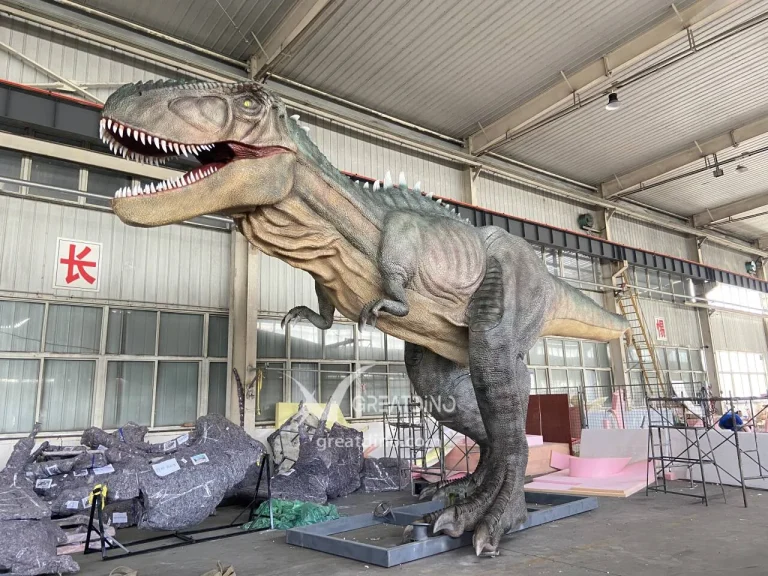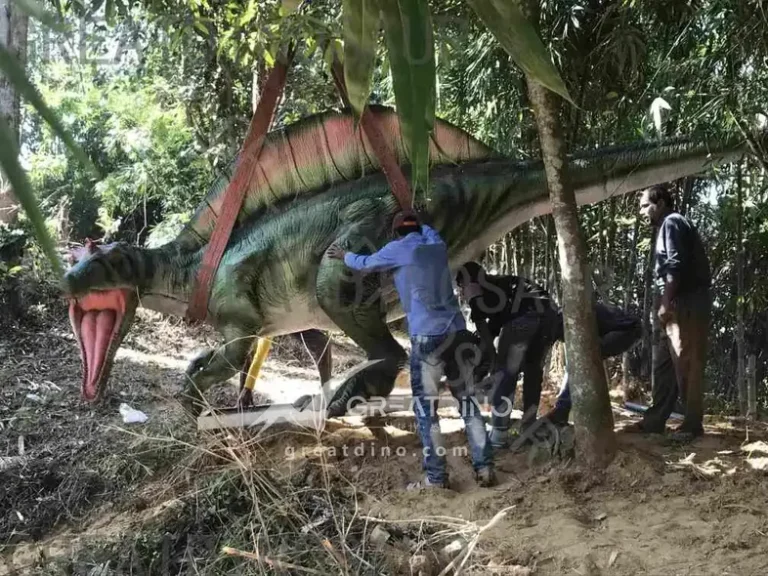
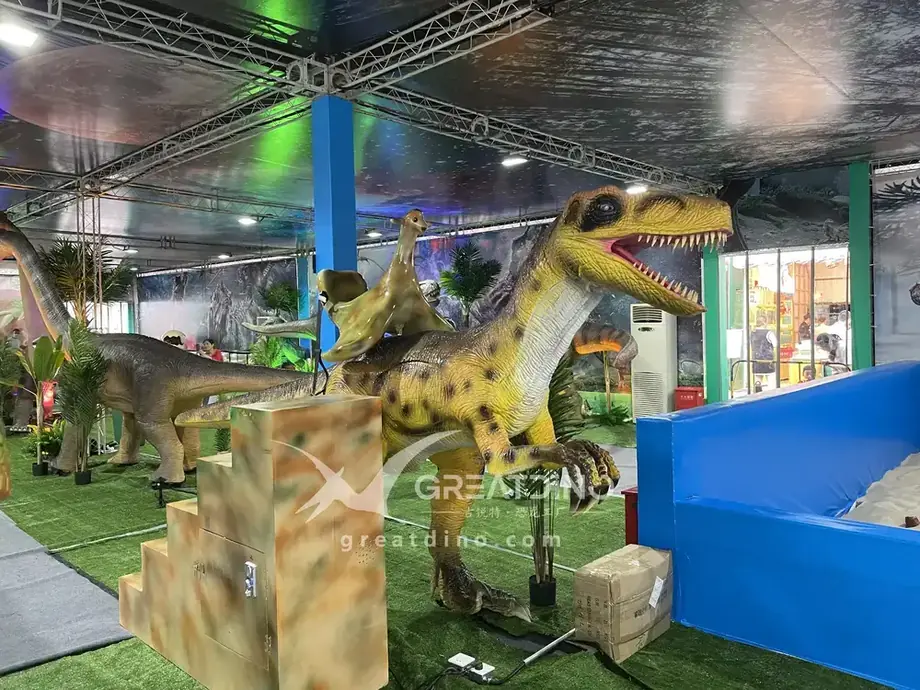
The same animatronic dinosaur sells into six very different businesses: a theme park that charges admission, a museum that answers to a curator, a mall that measures dwell time, a zoo with a licence to protect, a scenic area with no power at the far end, and a touring show that packs up every three weeks. The animal does not change. Everything around it does.
This guide takes each venue in turn and sets out what it actually demands — sightline, power, staffing, weather, compliance — so that a specification written for one is not quietly sent to another.
The six venues, side by side
| Venue | Viewing distance | Build emphasis | Biggest site constraint |
|---|---|---|---|
| Theme / dinosaur park | 3–10 m from a fenced path | Durability, throughput, low maintenance per unit | Footings and cable runs across large areas |
| Museum / science centre | 0.8–2 m, sometimes 360° | Accuracy, quiet motion, finish quality | Ceiling height, floor loading, fire code |
| Shopping mall / family centre | 1–5 m, high footfall | Noise, safety radius, compact footprint | Landlord approval, floor loading, opening hours for install |
| Zoo / safari park | 5–30 m, often from a vehicle | Silhouette, weather resistance, barrier integration | Animal welfare rules, biosecurity, drainage |
| Scenic area / trail | 2–15 m, uneven ground | Static or hybrid build, vandal resistance | No power, no road access, no staff on site |
| Touring exhibition | 2–8 m, changing rooms | Modular joints, crate design, fast assembly | Assembly labour, freight volume, repeated handling |
Theme and dinosaur parks: throughput per unit
A park is a queue business. What matters is how many visitors see the animal per hour and how rarely it stops working. That pushes the specification toward three things:
- Simple, robust movement. Two to four well-chosen axes look better from 6 m than eight axes nobody can see, and each extra axis is another thing to fail.
- Distance between units. 40–60 m along a path keeps people walking and spreads load on cable runs and footings.
- Service access from behind. A model 300 mm from a fence cannot be maintained. Leave 800 mm of standing room at the maintenance side, always.
Parks usually buy in phases: a gate piece first, then a trail, then a show area. Phasing is fine if the power and footings are planned for the finish, because digging up a path twice costs more than the second model.
Museums and science centres: the accuracy contract
A museum buys credibility. Two things follow that parks rarely think about:
- Close inspection. At under 2 m, seams, eye finish, teeth and the inside of the mouth are all visible. Skin quality dominates the budget here, not the mechanism.
- Evidence. Curators will ask which reconstruction the proportions follow. Supply the reference — skeletal drawing, paper, museum specimen — with the drawing package, and be ready to adjust posture to match a specific mount.
Noise is the other difference. Servo drives run quietly; pneumatic systems exhaust loudly. In a hall with hard surfaces and a school group, the noise floor matters. Specify servo for anything inside 2 m of a visitor and consider a slow, low-amplitude motion cycle rather than a dramatic one.
Indoor halls also constrain size physically. Check the freight lift, the door head, the ceiling minus 600 mm for head arc and lighting, and the floor loading at the four anchor points. An upper-floor gallery often needs a spreader plate that the landlord will want calculated.

Malls and family centres: noise, radius and permission
Retail is a landlord relationship before it is a design decision. Four items usually appear in the approval pack:
- Floor loading. A 5 m animatronic with a steel base concentrates load at its anchors. Provide the point loads in kN and a spreader plate detail.
- Safety radius. Moving parts need a barrier or a plinth that keeps hands out of joints. A 600 mm plinth solves most of it and reads as presentation rather than fencing.
- Noise. Compressors are usually refused outright. Servo or quiet DC only, and the sound system has to stay within the centre’s limit.
- Install window. Deliveries and assembly happen overnight, in a lift, within a few hours. Modular construction and pre-tested programs matter more than they do outdoors.
Dwell time is the metric the tenant cares about. A photo spot that holds a family for four minutes is a better retail asset than a spectacular animal nobody stops at, so put the model where the walk naturally slows, not in the middle of the concourse where people route around it.
Zoos and safari parks: barrier logic and biosecurity
In a zoo the animal is the exhibit and the model is the scenery — or the reverse, in a dinosaur safari. Either way, three rules apply:
- Never inside a live-animal enclosure unless the veterinary and welfare team has signed off. Models shed paint chips and attract visitors who lean.
- Barrier first, model second. Design the fence, ha-ha or moat line, then place the model so the visitor’s sightline clears it. Retrofitting a barrier around a delivered model is expensive.
- Drainage. Models set into planting collect water in the base. A 30 mm drain and 100 mm clearance under the frame prevents the most common corrosion complaint we see.
Safari drives change the viewing distance to 10–30 m. At that range, spend on silhouette and colour contrast against planting, and treat fine skin detail as optional. A slightly stylised model at 25 m reads better than a highly detailed one that disappears into shadow.
Scenic areas and trails: the unpowered problem
Scenic sites are where static models earn their place. If the nearest power is 300 m away and the ground is a protected slope, an animatronic unit becomes a civil works project. Practical pattern:
| Site condition | Recommendation |
|---|---|
| No power, no road access | Static fibreglass, delivered in sections by hand or by cable winch |
| Power within 50 m | One or two animatronic units at the main stop, static elsewhere |
| Public right of way, no staff | Static, vandal-resistant fixings, no exposed cable or cabinet |
| Seasonal closure | Either build, but plan a shutdown routine: isolate power, cover joints, inspect in spring |
Weight matters here more than anywhere else. Ask for the per-section weight before ordering, because the last 200 m of a forest trail is moved by people, not machines.
Touring exhibitions: designed for the third assembly
A touring show is not a park that moves. The failure point is the tenth pack-down, not the first install. Specify for that:
- Segmented bodies with numbered joints, so assembly is a sequence rather than a puzzle.
- Flight cases for control cabinets and cables, not cardboard. Loose cable is the most common touring failure.
- Program stored in two places — on the controller and on a USB stick that travels with the crate.
- Spares that match the build: one drive, one valve set, a length of each cable type, and the tools to change them.
Ask any supplier how long a full assembly takes with a crew of four. If the answer is vague, the model was designed for one install, not for ten.
Frequently asked questions
Which venue type is easiest to supply?
Indoor museums and malls: stable power, controlled weather, staff on site and short viewing distances that reward finish rather than size. Outdoor parks are harder because foundations, drainage and cable runs are often unfinished when the order is placed.
Can one model serve a park in summer and a mall in winter?
Only if it was designed as a touring piece: segmented, with flight cases, sealed connectors and a base that can be re-anchored. A park model moved indoors usually fails on door width, floor loading or noise before it fails mechanically.
Do zoos allow animatronic animals near real ones?
Sometimes, but never without the animal care team’s approval. The usual arrangement is a separate dinosaur trail on the visitor route rather than models inside enclosures, which avoids welfare questions and simplifies cleaning.
What about a mall with no exterior access after opening?
Everything must fit the service lift and the corridor corners. Ask for the tallest single-piece dimension and the crate dimensions early; a 4 m model that cannot pass the lift becomes a two-section model at extra cost.
How many models does a 1 km trail need?
Roughly 12–18, spaced 40–70 m apart, mixing static and animated. Fewer than 10 and the trail feels thin between stops; more than 20 and visitors stop looking closely at any of them.
Tell us the venue type, the walking route and where the power is, and we will propose a distribution of models along it rather than a shopping list. Send your project details, or start from the product ranges and the installed projects for reference layouts.