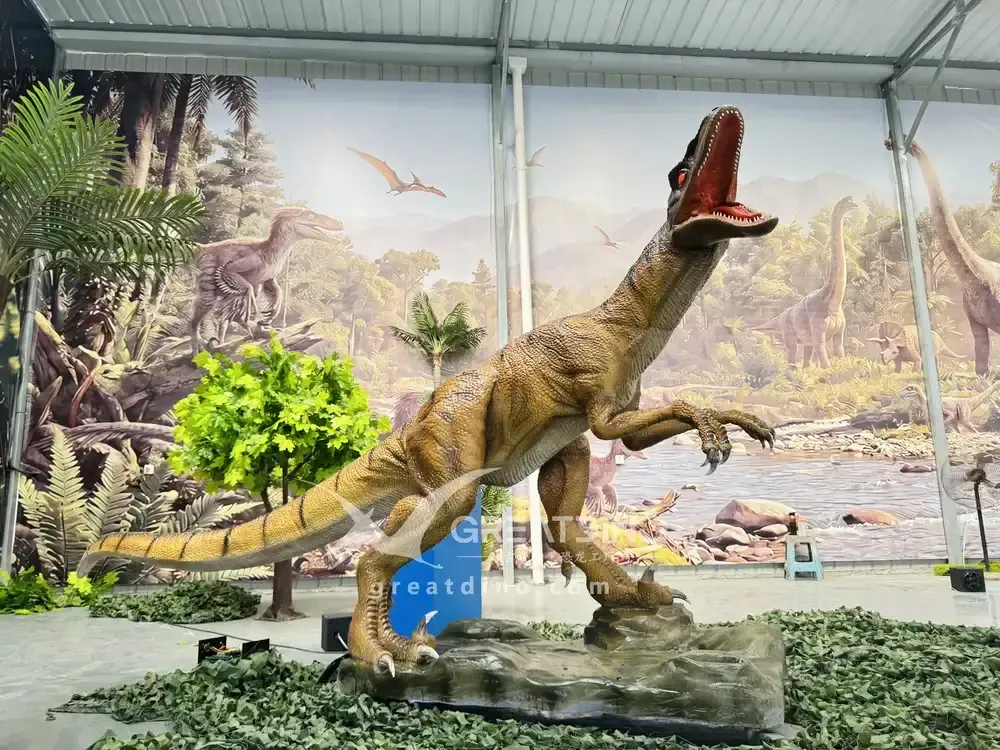
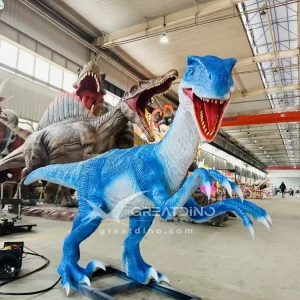
A velociraptor caught mid-alert: one foot up on rock, body turned, head swinging back to look behind it. Servo-driven, which is what allows the slow, small movements that make a predator read as alive instead of mechanical.
Every model is made to order. The figures below describe this build as specified; size, pose, colours and effects are configured around your site before the frame is laid out.
| Product type | Servo-driven animatronic dinosaur model |
|---|---|
| Overall size | Length 4 m, height approx. 2.2 m including rock base — custom sizing from 2 m to 8 m |
| Power | 110 V / 220 V, specified per site; CE / UL certified components available |
| Power draw | Lower than an equivalent pneumatic unit; consumption tracks actual movement |
| Control | Servo controller · remote · infrared sensor trigger · programmable sequence |
| Materials | Welded steel frame · servo actuators with planetary gearboxes · high-density foam · 3–4 layer silicone skin · cast resin rock base |
| Movements | Head turn and tilt back · neck extend and retract · jaw open and close · forelimb raise · tail sway · body rock · optional eye blink |
| Effects | Optional rasping call · LED eyes · mist · sensor-triggered alert sequence |
| Weather rating | Outdoor rated, with sun and lightning protection; servo units specified for dust ingress protection |
| Lead time | 40–55 days after drawing approval |
| Warranty | 2 years, with worldwide delivery and on-site installation support |
Most animatronic dinosaurs on the market run on pneumatic cylinders. Servo is a different animal, and the difference is visible from across a path.
A pneumatic unit moves between two positions: out and back, open and closed. It is fast, cheap and reliable, and it is why so many park dinosaurs move in a jerky rhythm. A servo unit moves to any position within its range, at any speed, and holds there. That means a head can turn slowly and stop halfway, a jaw can open a third of the way and pause, and a neck can extend with a smooth acceleration instead of a snap.
For a predator pose, that is the whole point. The alert sequence on this model turns the head in stages with holds between them — the animal looks, stops, looks further. That is what a hunting animal does. It is also quieter: no air exhaust hiss, which matters in a museum or an indoor exhibit where the compressor noise would carry.
This model is posed with one foot up on a rock, the body turned away from the approach and the head swung back over the shoulder.
That composition is deliberate. Visitors usually approach a trail animal from the side or behind, and a dinosaur facing straight ahead is static from those angles. With the head turned back, the animal looks at the visitor as they arrive, which is the moment the photograph happens. The rock under the foot is part of the composition rather than a plinth: it gives the raised foot a reason to be raised.
The trade-off is that a turned pose loads the frame asymmetrically. The neck drive carries the head off-axis, and the raised leg puts torque into the hip. We build the frame for that pose specifically, which is why the pose has to be fixed at drawing stage.
Buyers sometimes ask to delete the rock base to save height. On this model that is not a simple subtraction.
The base carries the raised foot, hides the anchor points and houses the cable entry. It is cast resin over a steel frame, textured to match the site’s stone where the client has a reference. Removing it means the raised foot has nothing to stand on and the pose collapses.
Where a site has its own rockwork or a landscaped mound, we build the model without the cast base and supply a mounting plate that the landscape contractor beds into their own stone. That version needs the rock dimensions before the frame is designed, because the foot height is set by the rock.
A servo unit in a theme park runs thousands of cycles a week, and the maintenance schedule reflects that.
The servos themselves are sealed industrial units, but the gearboxes and the linkage joints need inspection. We recommend a quarterly check of the linkage play, an annual lubrication of the joint bearings and a firmware and sequence backup each season. The controller logs fault codes, which turns most call-outs into a part swap rather than a diagnostic visit.
Dust is the main enemy at outdoor sites, which is why the servo specification includes an ingress rating. In a sandy or desert environment we add boots over the exposed linkages.
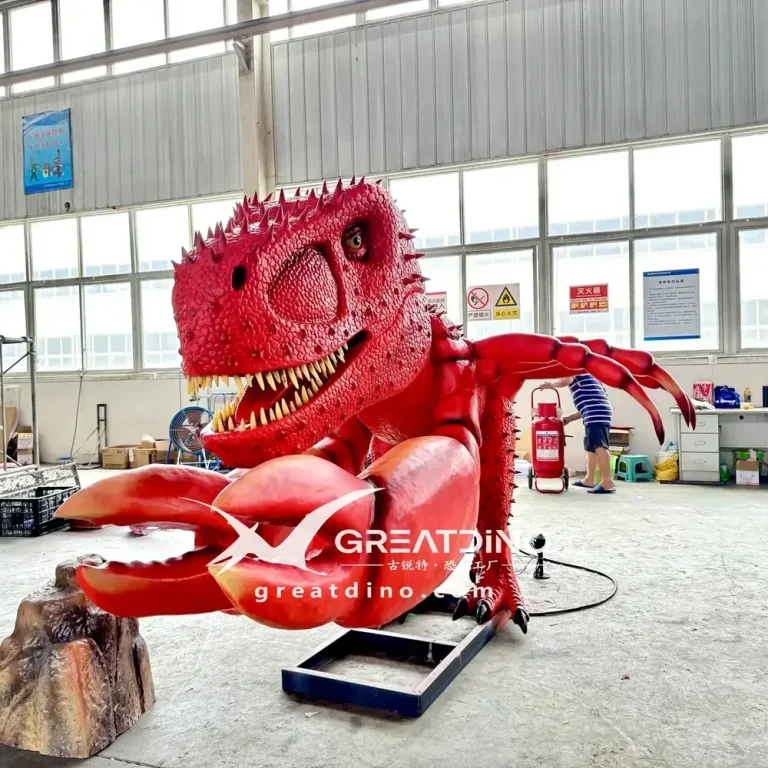 2.5M Animatronic T-Rex Crab Hybrid Statue
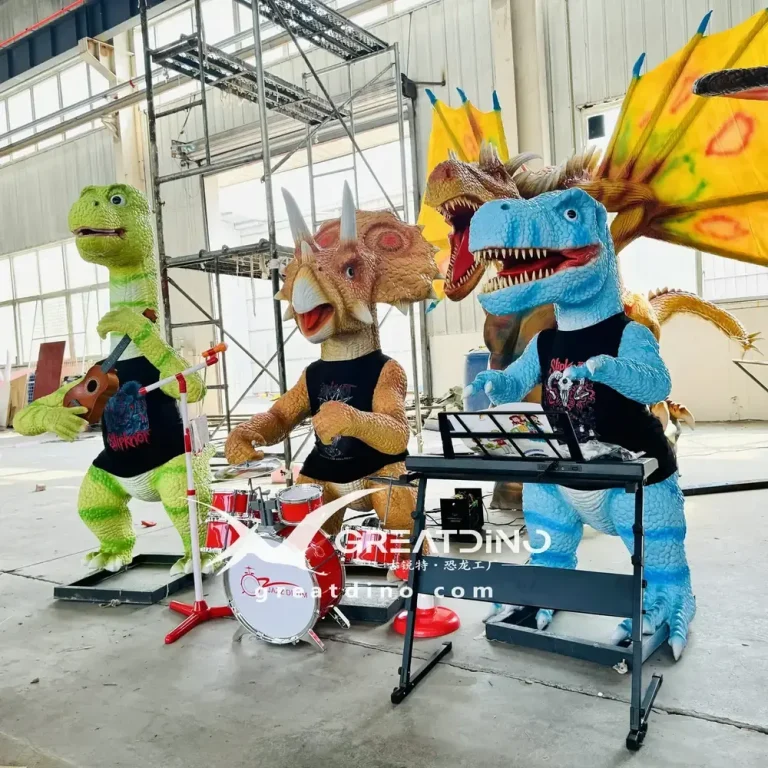 1.8M Animatronic Dinosaur Band with Music Performance
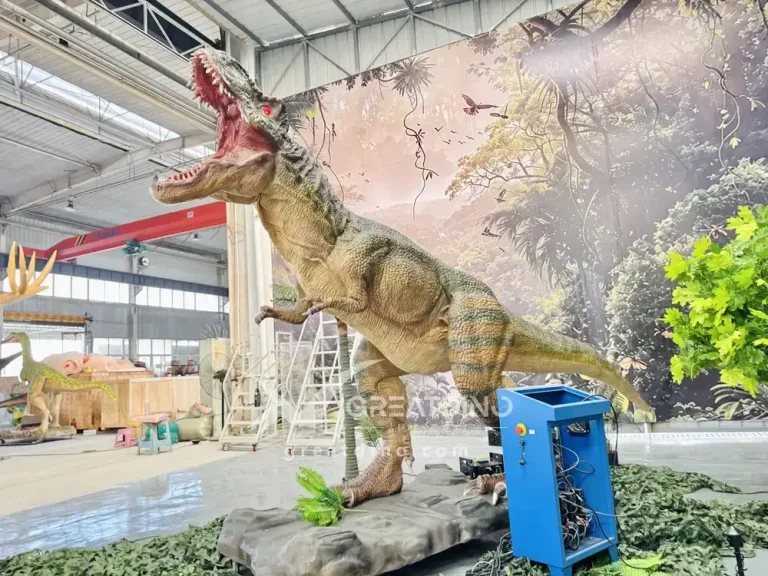 6M Servo-Driven Animatronic Dinosaur Model
Related reading: buying guides for museums and theme parks and the full high-tech custom models range.
The things buyers usually want settled before they ask for a drawing.
Pneumatic moves between two positions and back, which produces the jerky rhythm most park dinosaurs have. Servo moves to any position at any speed and can hold there, so the head can turn slowly and stop halfway. Servo is quieter and more precise; pneumatic is cheaper to build and service.
Yes. The sequence is programmed in the controller and can be edited on site, and we supply a backup file so a replacement controller can be loaded without reprogramming from scratch. Major changes to which parts move require mechanical work.
Yes — that is one of the reasons buyers choose servo. There is no air exhaust, so the only noise is the drive itself, which at slow speeds is close to inaudible at two metres. Pneumatic units in an indoor hall are noticeably loud.
Not without redesigning the pose — the raised foot is supported by the base and the pose depends on it. If you have your own rockwork we build a version without the cast base and supply a mounting plate for your contractor to bed in, but we need the rock dimensions first.
Quarterly check of linkage play, annual lubrication of joint bearings, and a sequence backup each season. The controller logs fault codes so most issues are a part swap. In sandy environments we add protective boots to the exposed linkages.
Yes, from 2 m to 8 m. Scaling changes the servo torque rating, the frame section and the foundation, so size is fixed before the frame is drawn. The pose and the rock base scale with the animal.
The model ships in sections, with the head and jaw crated separately. Assembly is typically one day on site with a small crane, followed by a full movement test before handover.
Every project ships with a spare-parts list, a maintenance guide and the wiring diagram. Servo units and the jaw drive are individually replaceable on site, so a component can be swapped without returning the animal to the factory. A 2-year warranty and worldwide delivery and installation support are included.