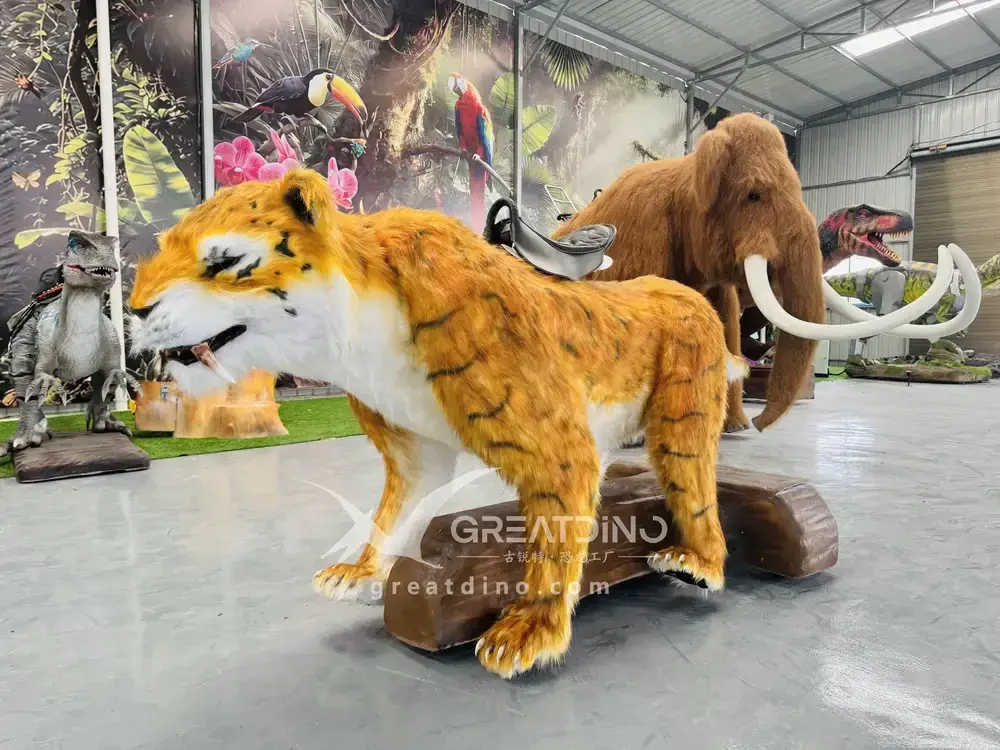
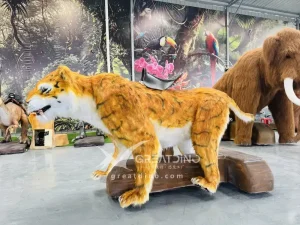
Custom-size Smilodon ride built to order — load-bearing chassis, coin or attendant control, and indoor or outdoor build.
Every model is made to order. The figures below describe this build as specified; size, pose, colours and effects are configured around your site before the frame is laid out.
| Product type | Rideable animatronic Smilodon, made to order |
|---|---|
| Overall size | Sized to the brief — built to the scene, not a stock size |
| Rider capacity | One rider per model, up to 80 kg; tandem body rated to 200 kg |
| Chassis | Heavy-section welded steel, braced at saddle and hip |
| Skin | Multi-layer silicone over foam, hand-painted, sealed seams |
| Ride speed | Walking pace, 2–4 km/h, set and locked on the controller |
| Controls | Coin timer or attendant remote · locked speed ceiling · emergency stop |
| Safety | Chest and lap straps · footrests · weight sensor cut-off · stop button |
| Power | 110 V / 220 V mains; battery pack for 6–8 hours intermittent use |
| Floor | Hard nylon wheels for tile and concrete; soft rubber for timber and carpet |
| Operation | Unattended coin mode or attended remote mode; convertible later |
| Packing | Timber crate with base plate, saddle and controller packed separately |
| Lead time | 30–45 days after drawing approval, plus freight |
| Warranty | 2 years, with worldwide delivery and installation support |
Every animatronic carries its own weight. A ride carries a rider on top of that, and the rider moves. That single difference changes the frame, the drive and the base, which is why a display model is never converted into a ride by bolting a saddle onto it.
The chassis on a ride is built from heavier section steel, braced at the saddle mount and at the hip, because a child shifting weight puts torque into the frame that a static pose never sees. The chassis is what separates it from a display build: a vehicle-style base drives it forward, back and sideways under a rider, with the fur laid over a load-bearing frame. The drive is geared for a walking pace rather than a fast strike, and the legs are built to carry load through the foot rather than to swing freely.
The saddle is not decoration. It is a moulded seat with a raised front lip, a chest strap and a lap strap, mounted through the frame rather than through the skin. Handlebars sit on the neck, forward of the rider, so a child leans into the movement instead of being pushed back by it.
Footrests are set low enough that a five-year-old can reach them and wide enough that a boot does not slip off during a turn. Under the seat there is a weight sensor: if the rider stands up mid-ride, the movement stops. Speed is set on the controller and locked, and a stop button sits within reach of the attendant.
Malls and indoor family centres usually take the coin version: a timer runs the ride for two to five minutes, a cash box sits in a locked panel, and the ride runs unattended between customers. Zoos and managed parks usually take the attendant version: a wireless remote, an adjustable speed ceiling and a staff member who decides when the ride starts.
Both versions use the same body. A coin unit can be converted to attendant control later without changing the model, which matters when a venue’s operating model changes after opening. Card and token readers are available where a mall runs a cashless floor.
Indoor rides are sized to the ceiling and the aisle. Outdoors the model is built with the same multi-layer silicone skin as a park piece, sealed at the seams, with the electronics in a sealed box and a battery option giving six to eight hours of intermittent use where no mains point runs along the route.
Throughput is set by ride length, not by the animal. A three-minute cycle with a one-minute turnaround moves about twelve to fifteen children an hour per unit, so a venue wanting a queue usually orders two animals rather than one faster one. A custom ride ships crated with the base plate, saddle and controller, and installs in a day.
Related reading: buying guides for museums and theme parks and the full dinosaur rides range.
The things buyers usually want settled before they ask for a drawing.
Most venues set a minimum of three years and a maximum rider weight of 80 kg. Footrests are positioned for a five-year-old and the chest strap adjusts down to a small child. We build the saddle to the age range you plan to admit, so tell us that before the frame is laid out.
Not on the standard body, which carries one rider. A tandem two-seat body is available for family venues where an adult rides behind a smaller child, rated to 200 kg, and it uses the same chassis and drive with a longer frame.
Only the attendant version. The coin version runs unattended between customers with a timer and a locked cash box, which is why malls choose it. The two share a body, so a coin unit can be converted to attendant control later without replacing the model.
A weight sensor under the saddle cuts the movement as soon as the load leaves the seat. The ride resumes when the child sits back down, and the attendant can stop it entirely from the remote. The speed ceiling is locked on the controller and cannot be changed from the floor.
Roughly twelve to fifteen with a three-minute cycle and a one-minute turnaround. Throughput is set by ride length rather than by the animal, so a venue expecting a queue usually orders two units instead of trying to speed one up.
The model ships in sections, with the head and jaw crated separately. Assembly is typically one day on site with a small crane, followed by a full movement test before handover.
Every project ships with a spare-parts list, a maintenance guide and the wiring diagram. Servo units and the jaw drive are individually replaceable on site, so a component can be swapped without returning the animal to the factory. A 2-year warranty and worldwide delivery and installation support are included.

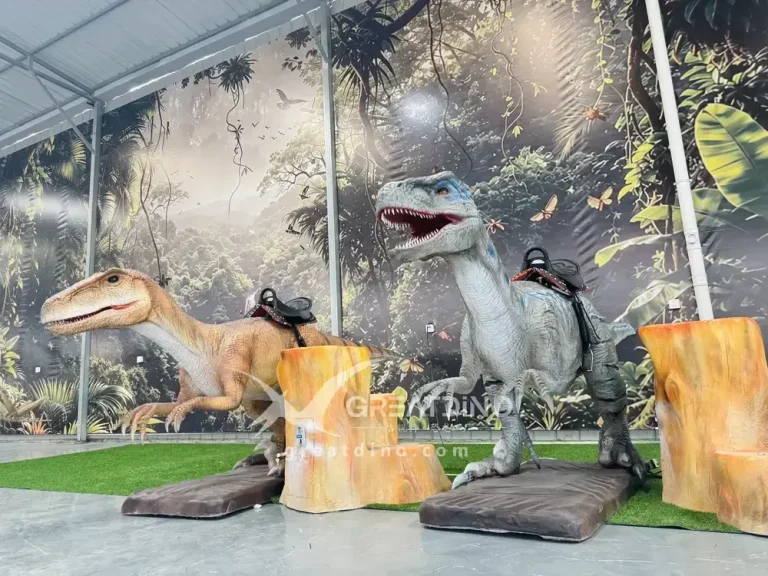 4M Rideable Animatronic Velociraptor Dinosaur Ride