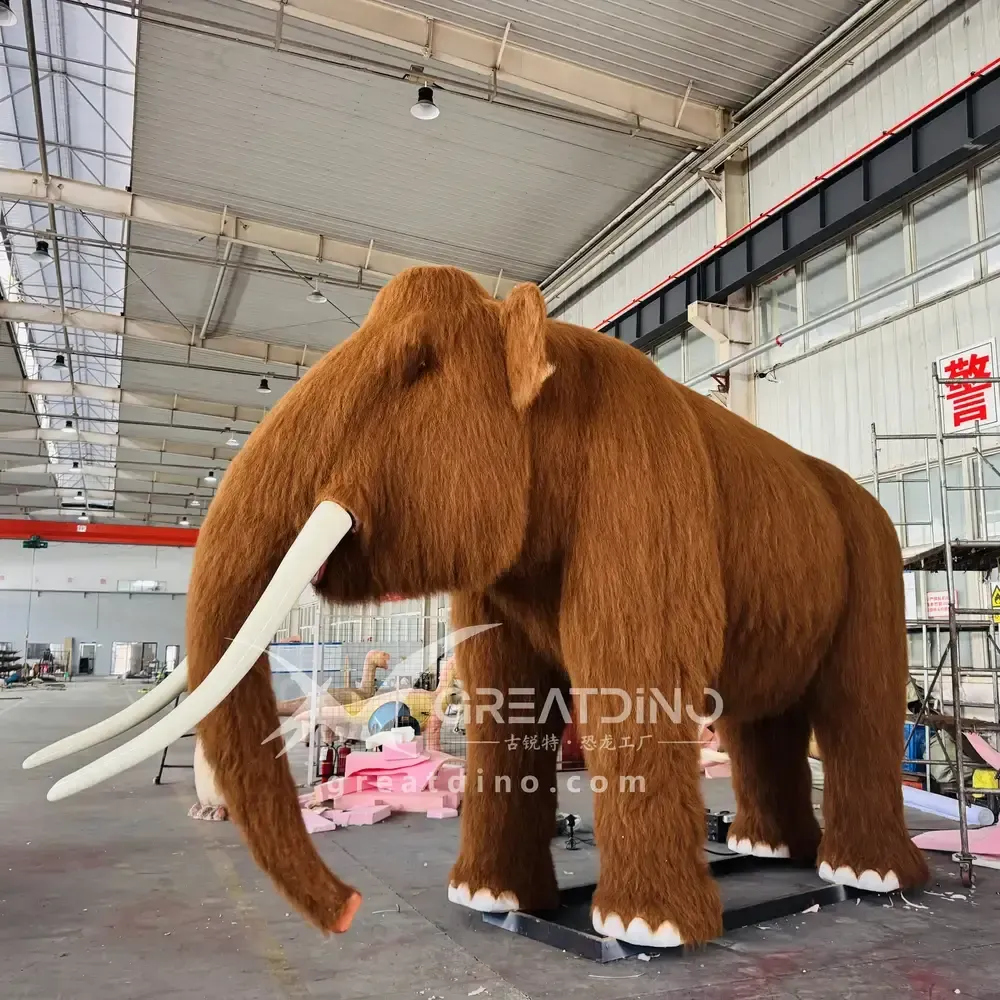
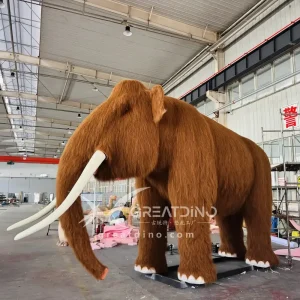
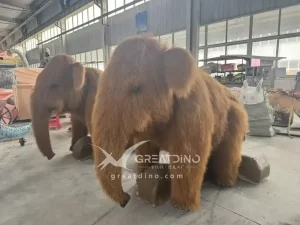
A five-metre woolly mammoth with a coat built from real fibre, not sculpted fur — because up close, visitors touch it. Curved tusks, a trunk that lifts and curls, and a head that turns slowly enough to read as weight.
Every model is made to order. The figures below describe this build as specified; size, pose, colours and effects are configured around your site before the frame is laid out.
| Product type | Large electric animatronic prehistoric animal model |
|---|---|
| Overall size | Length 5 m, shoulder height approx. 3.2 m — custom sizing from 3 m to 8 m |
| Power | 110 V / 220 V, specified per site; CE / UL certified components available |
| Power draw | Scales with movement count; heated enclosures not required |
| Control | Industrial controller · remote · infrared sensor trigger · timed loop |
| Materials | Welded steel frame, anti-rust treated · high-density foam · hand-fitted synthetic fur over silicone base · fibre mesh reinforcement |
| Movements | Head turn and nod · trunk lift, curl and swing · jaw open and close · tail sway · body rock · optional ear flap |
| Effects | Optional low rumble call · LED eyes · mist breath · sensor interaction |
| Weather rating | Outdoor rated, with sun and lightning protection; fur specified for wet climates on request |
| Lead time | 35–50 days after drawing approval |
| Warranty | 2 years, with worldwide delivery and on-site installation support |
A mammoth is judged by its coat before anything else, and a coat is the one thing that cannot be faked with paint.
Sculpted fur looks convincing in a photograph and wrong in person. We build the coat from synthetic fibre fitted strand by strand over a silicone base, layered heavier along the shoulders and the crown, thinner on the legs and the underside of the belly where a real mammoth wore its hair short. Direction matters as much as density: the fibre is laid backward along the flank and downward on the legs, which is what makes the animal read as one surface rather than a costume.
Because the coat adds weight and traps moisture, the frame and the electrical enclosures are specified for it from the start. A model designed as a smooth-skinned animal and then covered in fibre afterward will shed, sag and overheat.
The tusks are the second read, and they are also the part most likely to be damaged in transit or by a visitor.
We cast them as a hollow fiberglass shell with a steel core rather than a solid mass, which keeps the head light enough for the neck drive to move smoothly and lets a damaged tusk be replaced as a single part. The curve follows the species: sweeping out, then up and inward, with the tips crossing slightly in front of the trunk on a mature adult.
The trunk is a segmented tube on a multi-axis drive, able to lift, curl and swing. On a mammoth the trunk is shorter and thicker than an elephant’s, and the movement is slower — a fast trunk on a five-tonne animal breaks the illusion immediately. The jaw opens and closes for the call, and the head turns on a neck drive rated for the tusk load, not for a bare skull.
The same sculpt is specified two ways, and the choice should be made before production.
For an outdoor winter exhibit or a Christmas trail, the coat is built denser with a moisture-resistant backing, the frame is treated for freeze–thaw cycling and the electrical enclosures are sealed against snow and condensation. For a museum or an Ice Age gallery, the coat can be lighter, the movement cycle slower, and the model is often built with a smaller footprint to sit inside a display zone with interpretation panels.
Indoor units are frequently built as a partial animal — head, forequarters and one tusk set — where the gallery only allows a close viewing angle. That version costs less, weighs less and is easier to move between exhibitions.
A mammoth works because it is recognisable to visitors who know nothing about palaeontology. That makes it a strong anchor for an Ice Age zone, a winter festival entrance, or a natural history hall that needs one large draw.
It is a poor fit for a dinosaur trail with no Ice Age content, where it reads as out of place no matter how well it is built. The strongest installations pair it with a sabre-tooth, a woolly rhino or a cave-bear group, and set the lighting to a cold palette so the coat picks up blue rather than warm white.
We agree the pose, the viewing distance, the light direction and the foundation before steel is cut, and ship a plan for each so your contractor and your electrician work to the same drawing we built to.
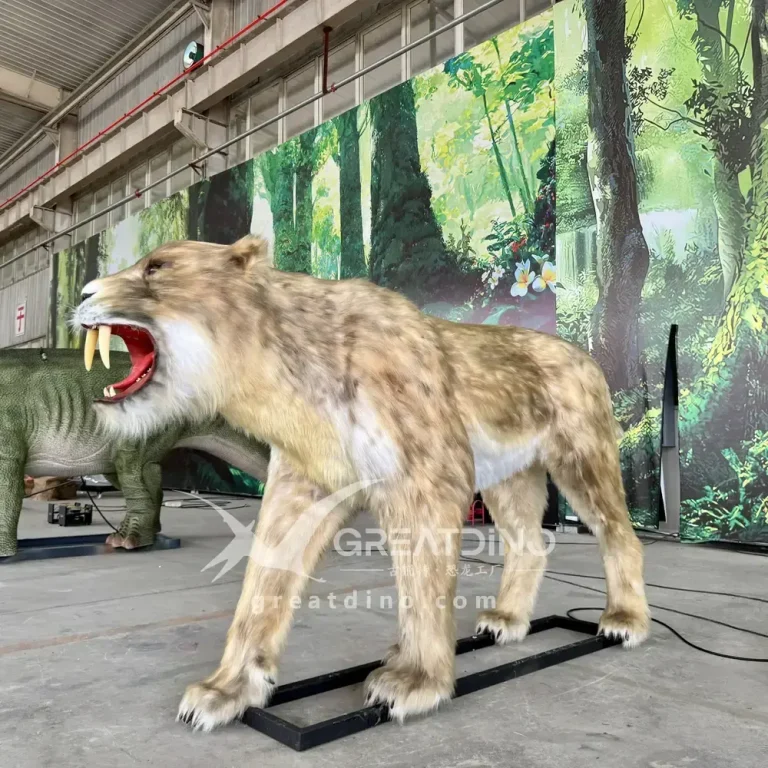 2.5M Animatronic Smilodon Ice Age Predator Model
 5M Realistic Animatronic Octopus Model
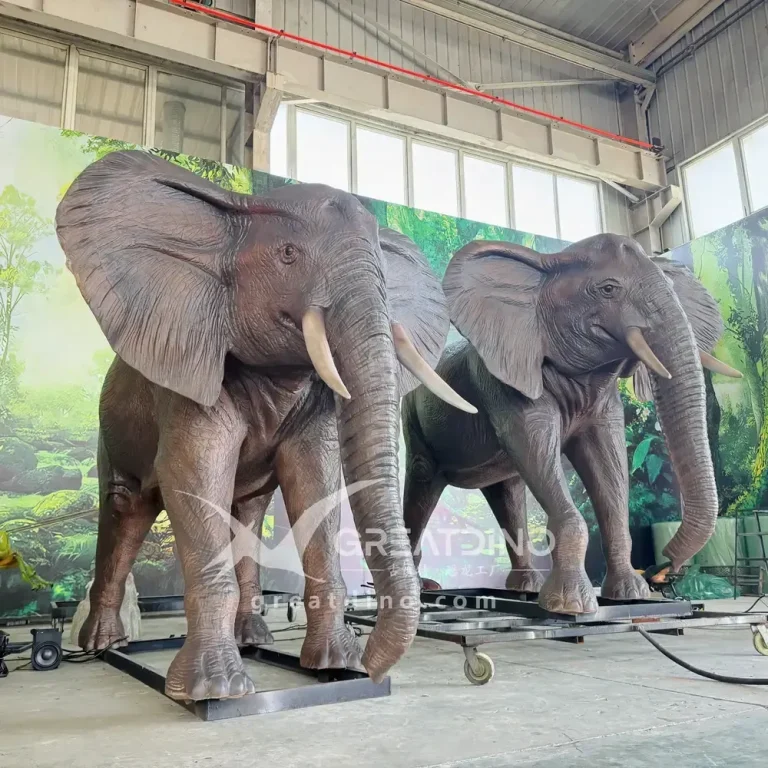 5M Animatronic African Elephant Pair
Related reading: buying guides for museums and theme parks and the full animatronic animals range.
The things buyers usually want settled before they ask for a drawing.
Real synthetic fibre, fitted by hand over a silicone base — not sculpted and painted. It is layered and direction-set the way animal hair lies, which is why it holds up to close viewing and to touch.
Yes. Loose fibre can be trimmed and re-fitted with the supplied patch kit, and the coat can be brushed and spot-cleaned. For permanent outdoor sites we supply a simple annual maintenance routine.
Yes, with the outdoor specification: moisture-resistant backing on the coat, anti-rust treated frame and sealed electrical enclosures. For a permanent wet-climate installation we specify the coat differently at the drawing stage.
Head turn and nod, trunk lift and curl, jaw open and close, tail sway and a slow body rock. Optional additions include ear flap, a low rumble call, LED eyes, mist breath and sensor-triggered movement.
A five-metre unit is a heavy static load, so we supply a foundation drawing with load points and recommended slab specification. Most sites use a reinforced concrete pad; soft ground needs a deeper footing design.
35–50 days after drawing approval, because the coat is fitted by hand. The model ships in sections with the tusks and trunk crated separately, and assembly on site is typically one to two days with a small crane.
The model ships in sections, with the head and jaw crated separately. Assembly is typically one day on site with a small crane, followed by a full movement test before handover.
Every project ships with a spare-parts list, a maintenance guide and the wiring diagram. Servo units and the jaw drive are individually replaceable on site, so a component can be swapped without returning the animal to the factory. A 2-year warranty and worldwide delivery and installation support are included.