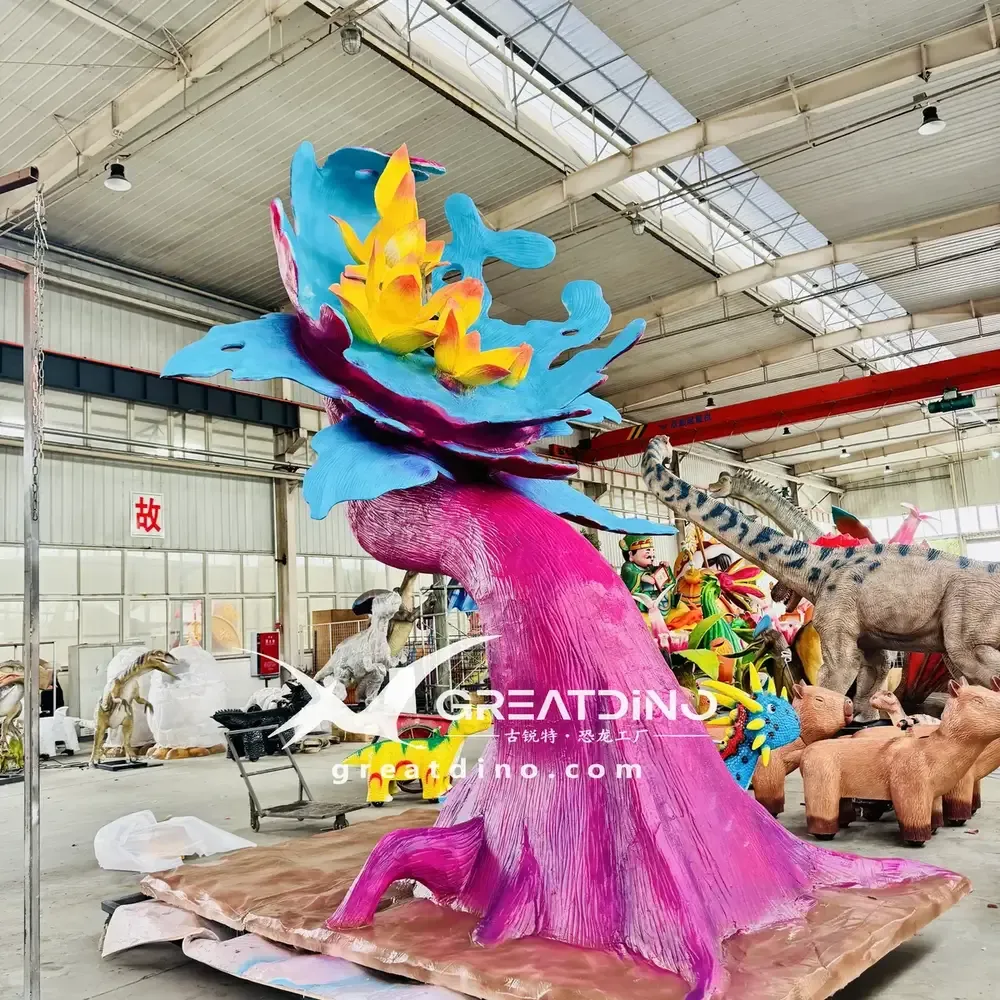
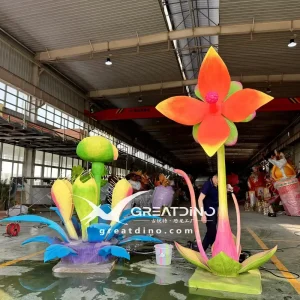
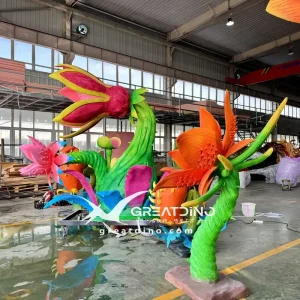
Oversized carnivorous blooms on moving stems — mouths that open as visitors pass, tendrils that curl, and colour that shifts after dark. Built as a cluster so it reads as a planting rather than a single prop.
Every model is made to order. The figures below describe this build as specified; size, pose, colours and effects are configured around your site before the frame is laid out.
| Product type | Animatronic plant cluster, multi-head |
|---|---|
| Overall size | Height 4 m, cluster spread approx. 3.5 m — custom sizing from 2 m to 6 m |
| Power | 110 V / 220 V, specified per site; CE / UL certified components available |
| Power draw | Scales with the number of heads and the LED load |
| Control | Industrial controller · proximity sensor · timed loop · remote override |
| Materials | Welded steel stems · high-density foam · 3–4 layer silicone petals and leaves · cast resin root base |
| Movements | Bloom open and close · stem bend and sway · tendril curl · optional inner-mouth extension |
| Effects | RGB LED glow inside the bloom · UV and colour wash on the petals · optional growl or rustle audio · mist |
| Weather rating | Outdoor rated, with sun and lightning protection; LED and drives sealed for wet operation |
| Lead time | 35–50 days after colour and layout approval |
| Warranty | 2 years, with worldwide delivery and on-site installation support |
A carnivorous plant at life size is a curiosity. At four metres it is a threat, and that change of scale is the entire design.
The effect depends on the visitor being able to walk under the bloom. At four metres the mouth opens above head height, the tendrils hang into the path, and the cluster spreads wide enough that you have to walk between the stems. That is what turns a decorated garden bed into a scene. Scaling down to two metres keeps the shape but loses the intimidation, and the piece becomes garden decor.
We build the cluster rather than a single bloom for the same reason: three or four heads at different heights and angles create a planting that surrounds the visitor, while one large flower is something they walk past.
The bloom is the mechanism buyers underestimate, because a flower that opens has to open from the centre outward without the petals colliding.
Each bloom runs on a ring mechanism: the petals are hinged at the base and driven outward together, so the mouth opens as a single coordinated movement rather than petal by petal. Inside the bloom there is a darker throat with cast teeth or spines depending on the species, lit from within. The open position is held, which is what makes the moment read — a bloom that snaps open and immediately closes looks like a mechanism testing itself.
Tendrils run on separate small drives, curling and uncurling on a slow independent cycle. They are deliberately out of sync with the blooms, so the cluster never moves as one unit. Stem bend and sway run underneath everything on a long, slow cycle.
This product earns most of its money after dark, and the lighting should be specified with that in mind.
The standard build has RGB LEDs inside each bloom, a UV wash on the petal undersides and a separate colour channel for the throat. At night the cluster can run a sequence — deep red at rest, brighter as a visitor approaches, a pulse when the bloom opens. The petals are painted with a pigment that responds to UV, so the colour shift comes from the paint as well as the light.
Daytime operation uses the same hardware with the LEDs off. The painted finish has to work on its own: saturated magenta, deep purple and acid green are the usual palette, with darker mottling toward the throat and a waxy sheen on the petal surface.
A cluster works best when it is designed into the path rather than placed beside it.
The usual layout is a narrowing: the path enters wide, the stems close in, and the visitor passes under the tallest bloom at the narrowest point. That sequence is what produces the reaction. We supply a layout plan showing stem positions, clearance heights, sensor positions and cable routes, so the landscape contractor can set the path and the electrician can trench before the models arrive.
Where the site has an existing planting bed, the models can be set among real plants for a blended effect, provided the bed drains and the root bases are above the water table. On a hard-surface path, the bases need anchor plates and the cable route runs in a covered channel.
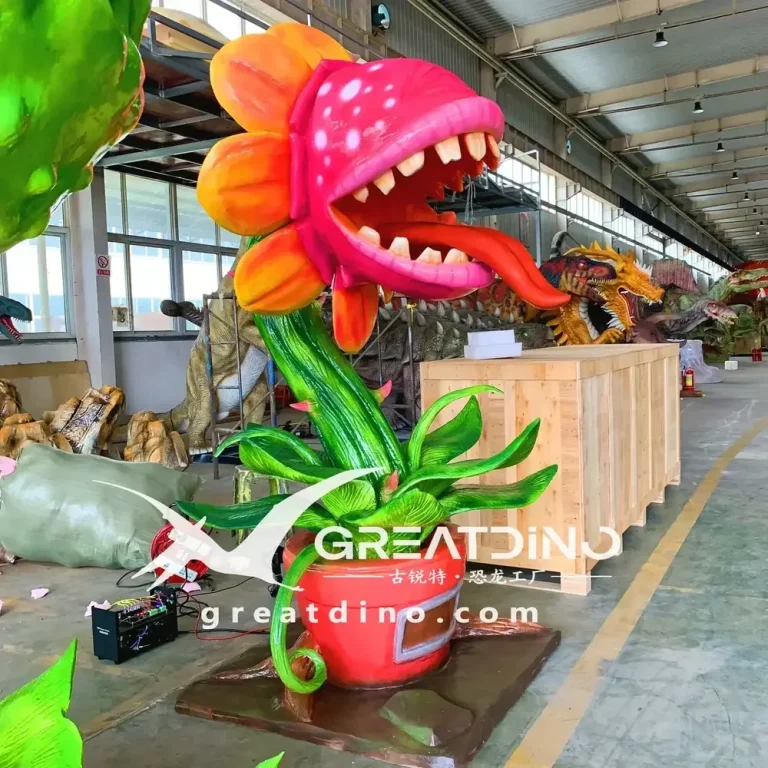 Animatronic Corpse Flower with Moving Neck and Sound
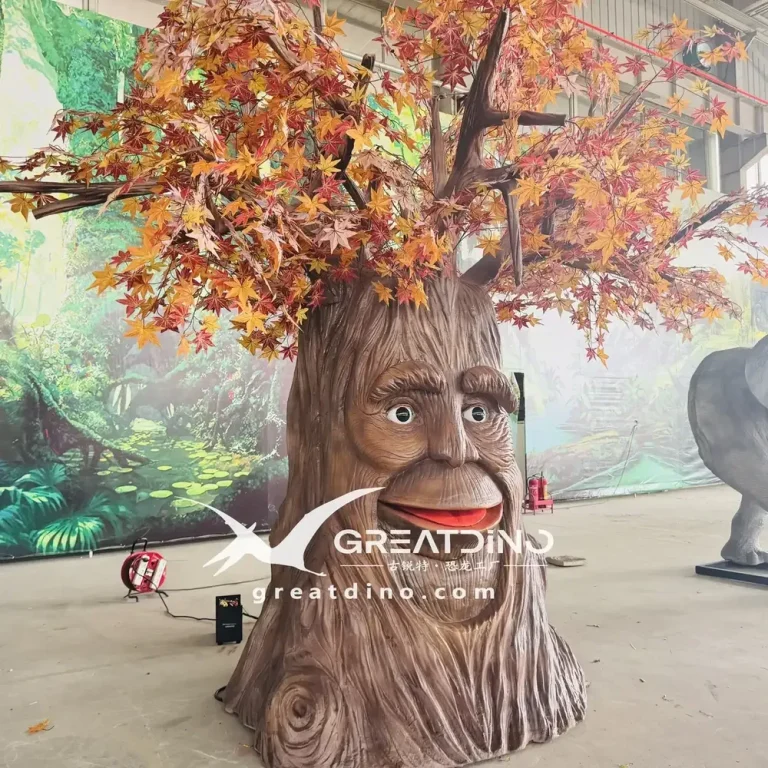 Interactive Talking Tree
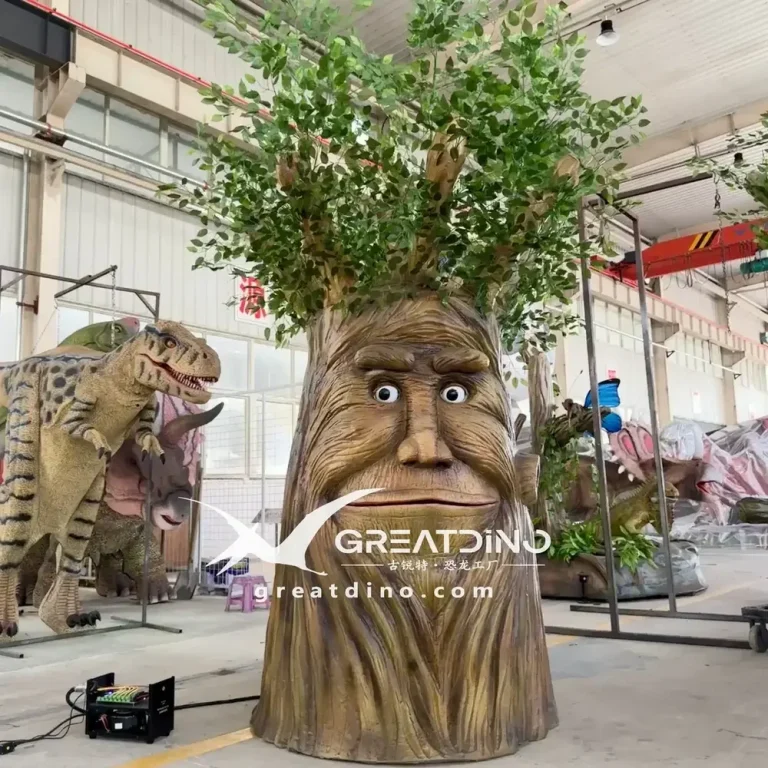 Animatronic Cartoon Talking Tree for Theme Parks
Related reading: buying guides for museums and theme parks and the full animatronic plants range.
The things buyers usually want settled before they ask for a drawing.
Yes, but a single bloom reads as a prop rather than a planting. The cluster is what creates the walk-through effect, because the visitor passes between stems. If space is tight, three heads at different heights work better than one large flower.
Yes. Each bloom opens on a ring mechanism with the petals driven outward together, holds in the open position, and closes later in the cycle. Tendrils curl on separate drives out of sync with the blooms, so the cluster never moves as one unit.
Yes. RGB LEDs inside each bloom, a UV wash on the petal undersides and a separate channel for the throat. The paint also responds to UV, so the colour shift comes from the surface as well as the light. Daytime operation runs the same hardware with the LEDs off.
Saturated magenta, deep purple and acid green with darker mottling toward the throat and a waxy sheen on the petals. The finish is designed to work without lighting, because most installations operate in daylight for part of the day.
Yes, and it usually looks better that way. The bed needs to drain and the root bases need to sit above the water table. We supply a layout plan with stem positions and clearance heights so the planting and the models can be coordinated.
Annual inspection of the petal hinges and tendril drives, cleaning of the LED lenses and the petal surface, and a check of the seals around the bloom throat. The mechanisms are sealed for wet operation but the hinges benefit from an annual clean and re-grease.
The model ships in sections, with the head and jaw crated separately. Assembly is typically one day on site with a small crane, followed by a full movement test before handover.
Every project ships with a spare-parts list, a maintenance guide and the wiring diagram. Servo units and the jaw drive are individually replaceable on site, so a component can be swapped without returning the animal to the factory. A 2-year warranty and worldwide delivery and installation support are included.