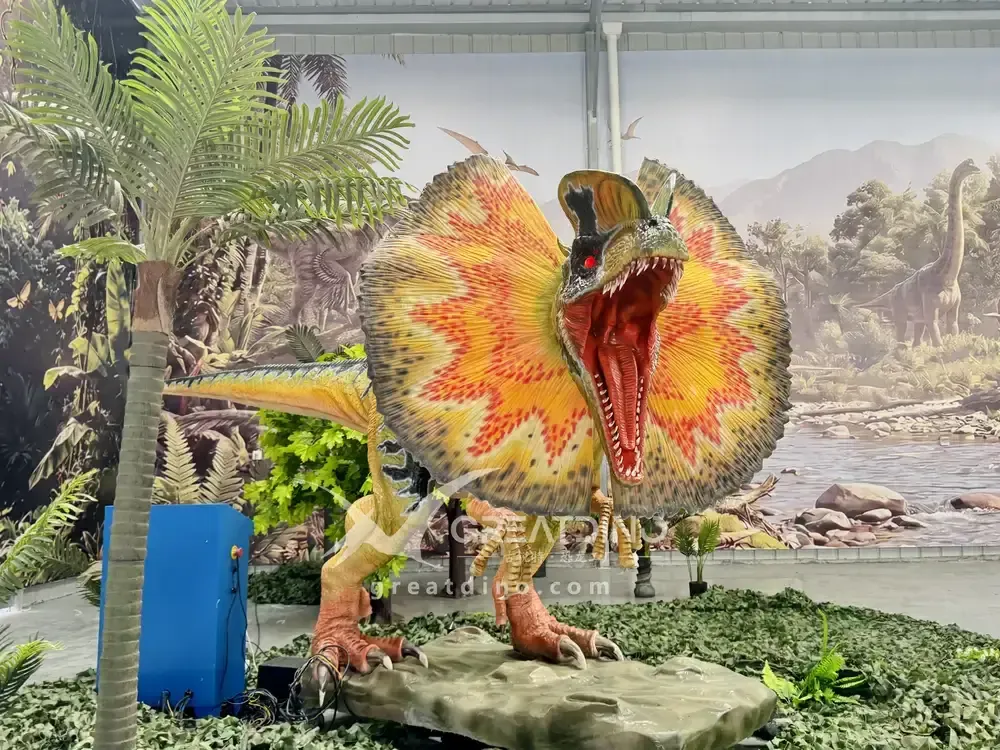
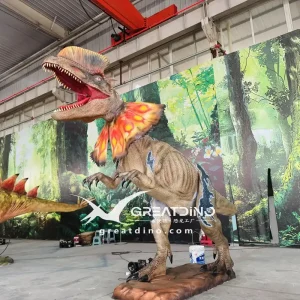
A five-metre Dilophosaurus on a rock base, with the twin crests that identify the species and a head that moves in small increments rather than snapping between positions. Servo-driven, so the motion holds at any point in its range.
Every model is made to order. The figures below describe this build as specified; size, pose, colours and effects are configured around your site before the frame is laid out.
| Product type | Servo-driven animatronic dinosaur model |
|---|---|
| Overall size | Length 5 m, height approx. 2.4 m including rock base — custom sizing from 3 m to 8 m |
| Power | 110 V / 220 V, specified per site; CE / UL certified components available |
| Power draw | Lower than an equivalent pneumatic unit; consumption tracks actual movement |
| Control | Servo controller · remote · infrared sensor trigger · programmable sequence |
| Materials | Welded steel frame · servo actuators with planetary gearboxes · high-density foam · 3–4 layer silicone skin · cast resin rock base |
| Movements | Head turn and lower · neck extend · jaw open and close · crest tilt · tail sway · body rock · optional eye blink |
| Effects | Optional hiss and rasp call · LED eyes · mist spray · sensor-triggered display sequence |
| Weather rating | Outdoor rated, with sun and lightning protection; servo units specified for dust ingress protection |
| Lead time | 40–55 days after drawing approval |
| Warranty | 2 years, with worldwide delivery and on-site installation support |
Almost every buyer who asks for a Dilophosaurus is thinking of one particular film, and the conversation has to start there.
The real animal had two rounded crests running along the top of the skull. It did not have a neck frill and it almost certainly did not spit. The film version added both, and that version is what visitors expect to see. We build both, and we ask which one you want before drawing.
The museum version carries the twin crests as sculpted bone forms with skin stretched over them, sized to the skull. The film version adds an expandable frill on a separate mechanism and a mist spray, and it is a different frame with more drives. Mixing the two — real crests with a film frill — produces an animal that satisfies neither audience.
A Dilophosaurus display is usually a slow one. The animal stands, lifts its head, opens the jaw and holds. Servo is what makes that readable.
On a pneumatic unit, the head snaps open and snaps shut, and the hold is a pause between two mechanical events. On this model the jaw opens to a set angle at a controlled speed, holds while the head turns, and closes on a different speed. The crest tilt and the neck extension are coordinated with the jaw, so the sequence reads as an animal displaying rather than a machine cycling.
The full display sequence runs about forty seconds and is triggered by an infrared sensor. Visitors who arrive mid-sequence still see it, because the controller restarts from the beginning when the sensor is re-triggered after a short gap.
The rock base on this model does three jobs, and the third one is the one that gets forgotten.
It carries the model, it hides the anchor bolts, and it routes the cable from the animal to the ground connection. The cable enters through a sealed gland at the back of the base and runs inside a conduit to the controller cabinet, which means there is no cable visible on the visitor side.
Drainage matters outdoors. Water collects in the hollow of a cast rock base, so we build a weep hole at the low point and set the internal electrical enclosure above it. On a site that floods, we specify a raised plinth instead and adjust the base height at drawing stage.
The same model is specified for two very different duty cycles.
An exhibition unit runs for a few weeks at a time, indoors, with a controlled temperature and a clean floor. The frame can be lighter, the skin finish can be finer, and the base can be a simple plinth. A park unit runs every day, outdoors, through rain and dust, and is climbed on by visitors who ignore the barrier. That version gets the sealed servos, the heavier frame, the outdoor skin specification and a base designed to take a foot on it.
Telling us which one at enquiry stage changes the frame and the price. Specifying an exhibition build for a permanent outdoor site is the most common expensive mistake in this category.
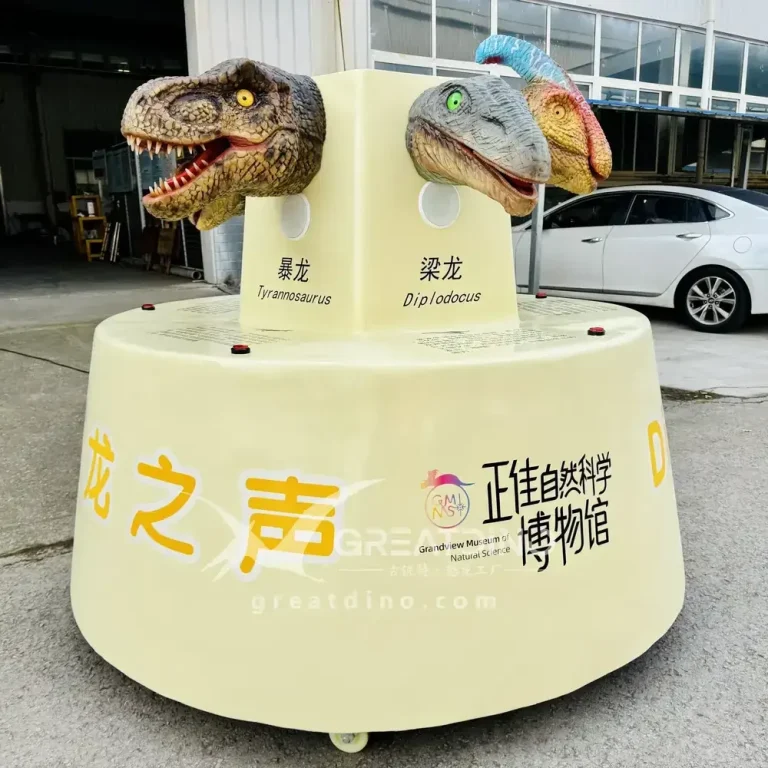 2M Interactive Dinosaur Exhibit for Museum Education
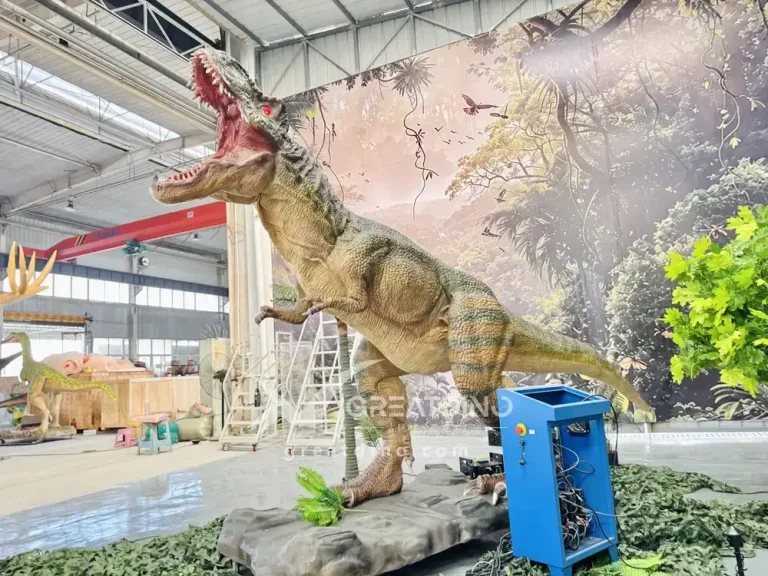 6M Servo-Driven Animatronic Dinosaur Model
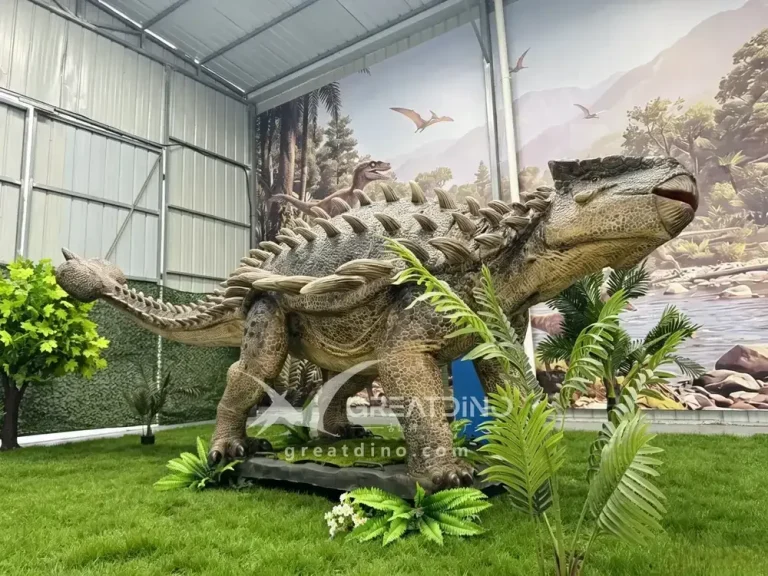 6M Servo Animatronic Ankylosaurus Model
Related reading: buying guides for museums and theme parks and the full high-tech custom models range.
The things buyers usually want settled before they ask for a drawing.
Yes, as a separate build. The real animal had twin crests and no frill; the film version adds an expandable frill and a mist spray on extra mechanisms. We ask which one you want before drawing, because the two frames are different.
Head turn and lower, neck extension, jaw open and close, crest tilt, tail sway and body rock, running about forty seconds and triggered by an infrared sensor. Eye blink and a hiss effect are optional. The sequence is editable on site.
The display is slow and held, and servo is the only drive that holds a position smoothly. A pneumatic jaw snaps between open and shut, which reads as mechanical. Servo is also quieter, which suits indoor exhibition spaces.
Yes. The base is cast resin and can be textured and coloured to match a stone reference, and we can build the model without a base for sites that have their own rockwork, provided we have the rock dimensions before the frame is drawn.
The cable enters through a sealed gland at the back of the base and runs inside conduit to the controller cabinet, so nothing is visible from the visitor side. We supply the conduit route and the cabinet position on the site plan.
Quarterly linkage check, annual lubrication of joint bearings, seasonal sequence backup, and inspection of the base gland and weep hole. The servo actuators themselves are sealed units. Dusty sites get protective boots on exposed linkages.
The model ships in sections, with the head and jaw crated separately. Assembly is typically one day on site with a small crane, followed by a full movement test before handover.
Every project ships with a spare-parts list, a maintenance guide and the wiring diagram. Servo units and the jaw drive are individually replaceable on site, so a component can be swapped without returning the animal to the factory. A 2-year warranty and worldwide delivery and installation support are included.