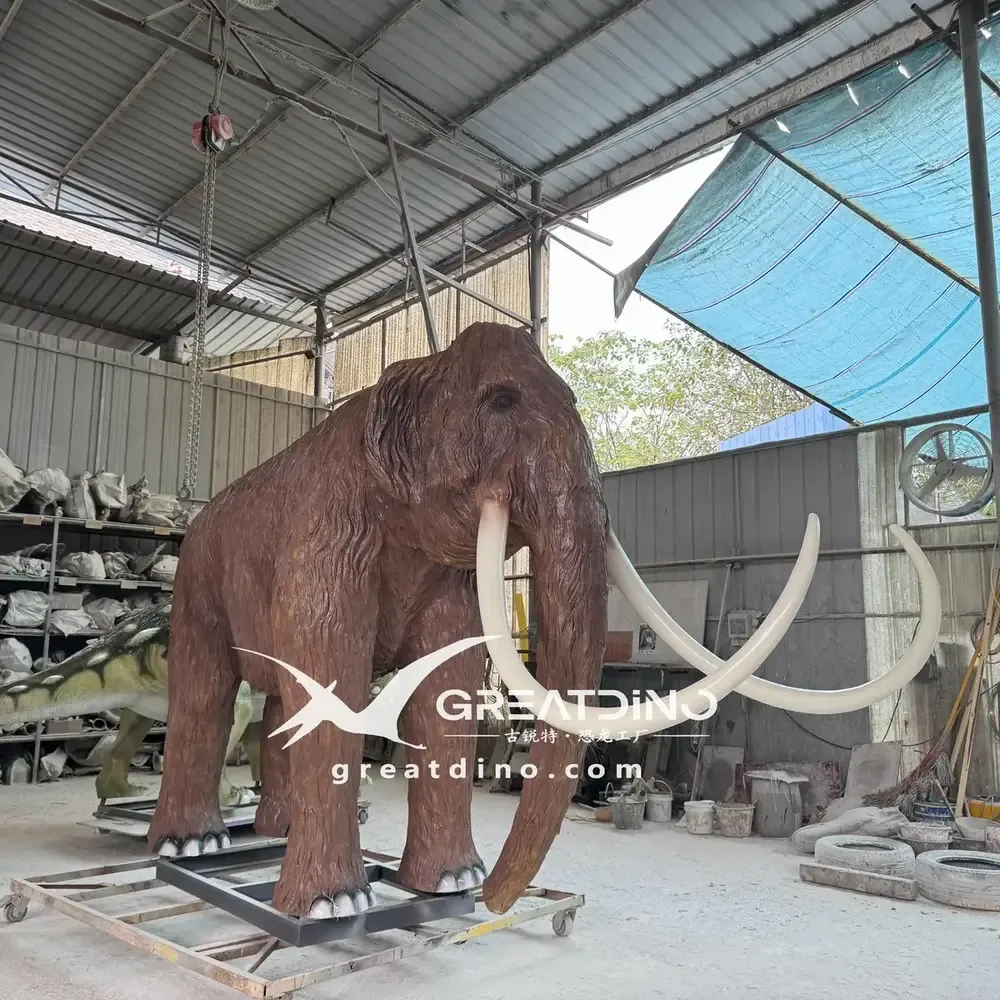
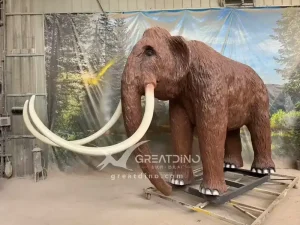
A five-metre mammoth in fiberglass, with the coat carved rather than painted on — layered fur grooves that hold shadow at the shoulder and thin out along the legs. Curved tusks, sealed surface, no power required.
Every model is made to order. The figures below describe this build as specified; size, pose, colours and effects are configured around your site before the frame is laid out.
| Product type | Static fiberglass prehistoric animal replica |
|---|---|
| Overall size | Length 5 m, shoulder height approx. 3 m — custom sizing from 3 m to 10 m |
| Power | None required — static model |
| Structure | Steel internal armature bonded into the fiberglass shell |
| Finish | Gel coat, filler, primer, layered acrylic and automotive clear coat |
| Materials | Fiberglass shell with resin and steel armature · cast resin tusks with steel core · UV-stable pigments |
| Detail | Carved fur layers · domed skull · curved tusks · trunk with cast rings · four-toed feet |
| Mounting | Free-standing, or on a supplied steel base for soft ground |
| Weather rating | Outdoor rated, UV-stable, frost resistant; no electrical components to protect |
| Lead time | 25–35 days after drawing approval |
| Warranty | 2 years on structure and finish, with worldwide delivery and installation support |
A fiberglass mammoth lives or dies on how the coat is handled, and there are only two honest options.
The first is to sculpt the fur as a surface: grooves cut in bands that follow the animal’s hair direction, deeper at the shoulder and the crown, shallower down the legs and along the belly. That is what we do on this piece. The grooves hold shadow, so the coat reads as mass rather than pattern from a distance, and the direction of the cuts is what makes the body look like one continuous animal.
The second option is a printed or painted fur pattern, which is faster and looks acceptable in a photograph and wrong in person, because it has no depth under real light. We only use it on small decorative pieces where the viewing distance is over fifteen metres.
On a mammoth, the tusks are the feature that visitors walk towards, and the one most likely to be broken.
We cast them as a hollow fiberglass shell with a steel core running into the skull, which keeps the weight down and gives the tusk enough give to survive a knock without shattering. The curve sweeps out, then up and inward, with the tips crossing in front of the trunk. On the fiberglass piece the tusks are fixed; on the animatronic version they can be removed for transport, and we build this one the same way where the size requires it.
The trunk is sculpted with cast rings and a slight lift at the tip, in a pose that suggests the animal is about to raise it. A trunk hanging dead straight reads as broken.
The process behind a piece this size is worth knowing, because it explains the price difference between a fiberglass replica and a hand-carved foam sculpture.
We sculpt in clay or foam first, then take a multi-part mould from the sculpt. The production shell is laid up in that mould over a steel armature, so every unit is identical and the wall thickness is controlled. The shell is then filled, faired, primed and painted by hand — which is where the variation between units comes from, and why a hand-painted finish looks different from a sprayed one.
Moulds have a service life. For a large piece like this we keep the mould and can produce matching units years later, which matters if a park is building a trail in phases and wants the fifth mammoth to match the first.
A static mammoth is the cheapest way to anchor an Ice Age zone, and it is often the right first purchase.
It needs no power point, no controller and no maintenance contract. It can be installed by a local contractor with a crane in half a day. And because it costs a fraction of the animatronic version, the same budget can cover a mammoth, a sabre-tooth and a woolly rhino group, which reads as a complete scene rather than a single animal standing alone.
Where the budget allows, the usual pattern is one animatronic anchor — the mammoth with a moving trunk and head — plus static companions. The visitor reads the moving animal first and the static ones fill the scene around it, and the group looks complete from every approach.
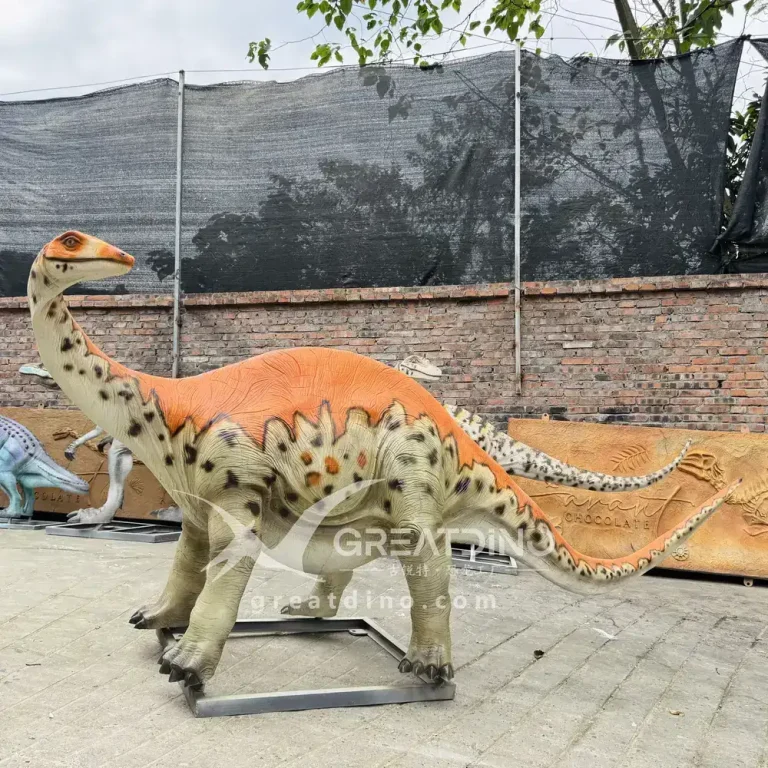 4M Fiberglass Melanorosaurus Sculpture
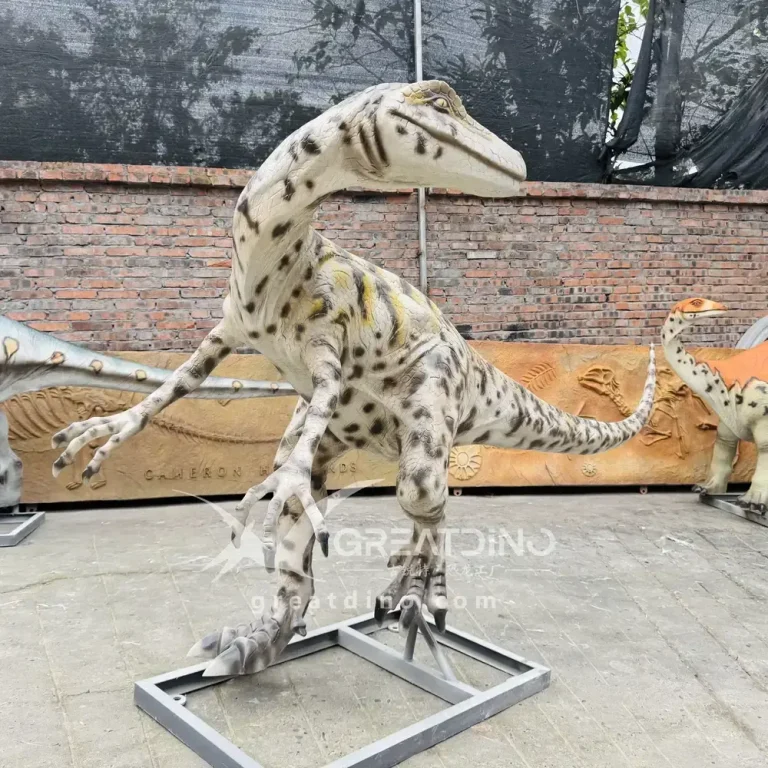 3M Static Fiberglass Herrerasaurus Sculpture
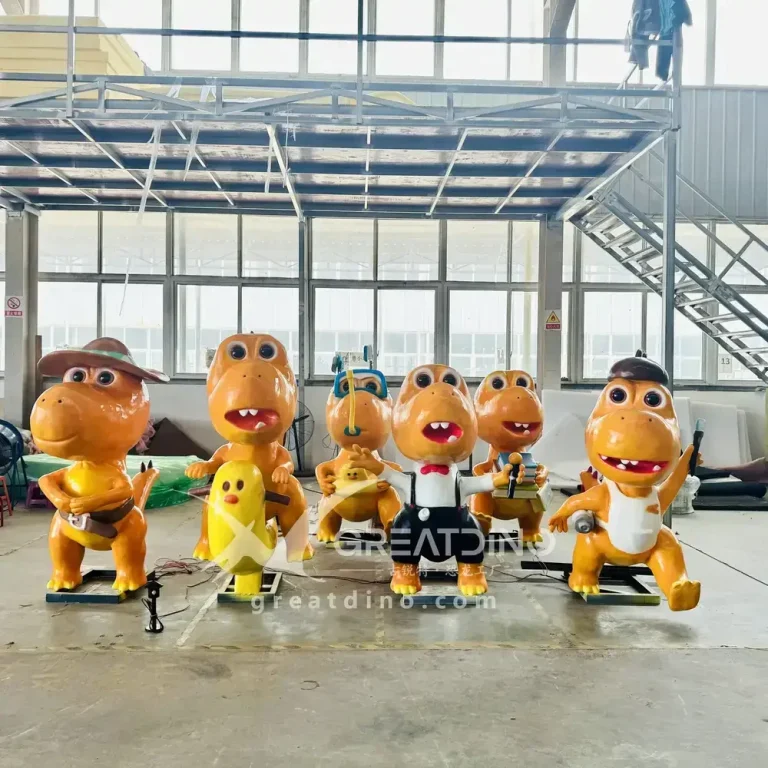 1.5M Fiberglass Cartoon Dinosaur Sculpture Set
Related reading: buying guides for museums and theme parks and the full fiberglass statues range.
The things buyers usually want settled before they ask for a drawing.
Sculpted. The fur is cut into the surface in bands that follow the hair direction, deeper at the shoulder and crown and shallower on the legs. It has real depth, so it holds shadow under outdoor light rather than reading as a flat pattern.
On pieces where the overall size requires it, yes — the tusks are a separate casting fitted to the skull and can be removed, crated and refitted on site. On the standard five-metre unit they ship fitted and protected.
Significantly lower, because there is no frame drive, no controller, no wiring and no electrical specification. It is the usual first purchase for a new Ice Age zone, with the animatronic version added later as the anchor.
The finish is an automotive-grade clear coat with UV stabilisers over layered acrylic, which is what prevents the chalky fade common on cheap fiberglass. In high-UV climates we add a second clear coat and specify a lighter base tone.
Yes, if we have the mould or the original drawings. If the piece came from another supplier we can scan it and build a new mould, which is worth doing if you plan to add more units later.
Delivered assembled up to about 4 m; larger pieces split at the waist with a bolted, sealed joint. A local contractor with a small crane sets it on the pad in a few hours. We supply the footing drawing and the joint sealing instructions.
The model ships in sections, with the head and jaw crated separately. Assembly is typically one day on site with a small crane, followed by a full movement test before handover.
Every project ships with a spare-parts list, a maintenance guide and the wiring diagram. Servo units and the jaw drive are individually replaceable on site, so a component can be swapped without returning the animal to the factory. A 2-year warranty and worldwide delivery and installation support are included.